Home Blog Page 20

Recommendations for Romania’s Long-Term Strategy: Pathways to Climate Neutrality

Decarbonisation will not be achieved merely through political commitments, it also requires rigorous evidence-based planning. Romania still needs to publish its long-term strategy (LTS)
on how decarbonisation will be achieved by 2050. Since the initial deadline of January 1st, 2020, several key events and EU-level strategies have unfolded, which should be taken into account in
Romania’s upcoming LTS. The European Green Deal and the Fit-for-55 package brought forth a whole new level of ambition for GHG emissions reduction, while the REPowerEU will accelerate
the pace of the climate transition in the short and medium-term, following Russia’s invasion of Ukraine. The Romanian LTS needs therefore to outline a plan for the rapid decarbonisation of the
economy with the prospect of reaching climate neutrality before mid-century.

District heating in national Long Term Strategies November 2022 - epg7

This report is part of the project Climate Recon 2050 – Dialogue on Pathways and Policies for
a climate-neutral EU. For further details, please visit the project website.

Phasing out coal in Romania: an assessment of the governance framework

Phasing out coal represents a cornerstone of decarbonising power production. Most European countries have committed to phaseout coal within the next decade, with Romania joining the list this year. This represents a remarkable development given the context in which legislation for retiring Romania’s lignite and hard coal power plants was passed – the fossil gas crisis triggered by Russia spilled over in the entire energy sector leading to skyrocketing prices. As a response, some EU countries have delayed phaseout plans, which can provide much needed relief in times of crisis, despite the temporary increase in emissions. Nonetheless, it must be understood that such emergency measures are temporary in nature and should not affect the long-term commitments to phaseout coal capacities.

These developments rather offer the opportunity to accelerate the deployment of renewable energy in order to ensure a coal-to-clean transition which would no longer rely on an intermediary transition to gas. The current energy crisis has laid bare the risks associated with the EU’s dependence on fossil gas imports.

In this context, the main challenge is to sustain a coal phaseout that is as swift as possible while also ensuring security of supply, affordable electricity, and a just transition in coal-dependent regions. A coherent phaseout calendar remains just as necessary for avoiding a disorderly crash of the sector and for allowing sufficient time to build realistic plans for economic redevelopment. Romania did just that by passing legislation to fulfil the commitment in its National Recovery and Resilience Plan to eliminate coal from the electricity mix by the end of 2032. Despite some flaws and being less ambitious than the initial legislative proposal, Law 334/2022 sets a clear coal exit date, includes power plant closure benchmarks, introduces social protection measures, establishes governmental and advisory bodies to manage the implementation process and sets sanctions for non-compliance with the calendar. Some issues that remain to be addressed are more transparency on how technical reserves will be created and how will they be remunerated, elaborating more comprehensive just transition measures, better ensuring public participation, and properly enforcing the legislation. Romania’s Territorial Just Transition Plans have also been approved by the Commission, creating the framework for the economic redevelopment of coal regions such as Gorj and Hunedoara. 

Based on an assessment of best practices and other European experiences with phasing out coal, this report highlights the importance of setting into law ambitious targets for a coal exit calendar. Different policy instruments can be used to implement this, such as minimum CO2 price floors or scheduled retirements of individual power plants. The latter appears to be most effective in a country like Romania, but it should be further analysed whether a calendar of decreasing GHG emissions standards for power production could be more suitable for phasing out all fossil fuels from the electricity mix in the long run. Besides, ensuring a just transition from coal does not stop at mitigating the immediate impact on job losses, as it also entails investing in the economic redevelopment of the coal regions. Funding the transition should not stop at accessing European finance – synergies between EU funds and national or private financing streams are also important. Stakeholder and community engagement also need to be ensured to foster public acceptance.

An assessment of Bulgaria’s Long-Term Strategy

As part of the Climate Recon project, EPG has assessed the Long-Term Strategy for climate neutrality of Bulgaria.

Long-Term Strategies are key instruments for Member States to meet their emissions targets. They vary in their concreteness, scope and level of detail, leading to uncertainties in how Member States will reduce their emissions to meet the EU’s climate neutrality targets. This analysis reviews the Long-Term Strategy of Bulgaria and assesses how fit-for-purpose it is in providing a robust pathway for emissions reductions.

The report is part of the project Climate Recon: Dialogue on Pathways and Policies for a climate-neutral EU. This project is financed by the European Climate Initiative (EUKI) and the European Climate Foundation (ECF). For further details, please visit the project website www.climatedialogue.eu.

What’s holding back large-scale renewable deployment in Romania?

Interest in renewable investments in Romania is back. It is now clear that renewable energy is the key to solving two of the main challenges currently faced throughout Europe: ensuring energy security and reducing greenhouse gas emissions. As a net electricity importer and having faced stubbornly high electricity prices even compared to other EU countries, Romania stands to benefit greatly from further tapping into its renewable
potential. However, old barriers persist, while new ones have all but blocked investments. These barriers must be addressed to enable a true shift of gears towards a renewables-driven future at national level.

From the moment of the first investments in the renewable sector, some more than 15 years ago, Romania’s attitude and approach towards wind and solar energy oscillated between extremes: from one of the most attractive investment environments in Europe, to one dominated by unsurmountable political and administrative barriers. This volatility was only worsened by the two major challenges of the past years: the COVID pandemic and the Ukraine war, with its second front on the European energy markets.

District heating in national Long-Term Strategies

Member States’ visions for enabling low-carbon district heat networks

As part of the Climate Recon project, EPG has analysed the role of low-carbon district heating in the Long-Term Strategies for climate neutrality of 23 Member States.

Modern, low-carbon district heat networks could significantly contribute towards the decarbonization of heating supply, particularly in the residential sector. However, they only supply 12% of heat in the EU, and some countries struggle with inefficient legacy networks in need of repair and upgrading. This analysis reviews countries’ Long-Term Strategies and analyses how well they tap into the decarbonization potential of low-carbon district heat networks.

The report is part of the project Climate Recon: Dialogue on Pathways and Policies for a climate-neutral EU. This project is financed by the European Climate Initiative (EUKI) and the European Climate Foundation (ECF). For further details, please visit the project website www.climatedialogue.eu.

Joint Letter for an Ambitious EU Solar Rooftop Mandate

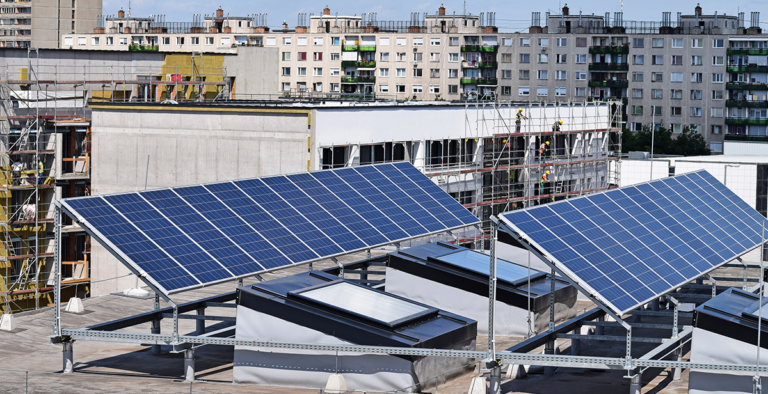
The Energy Policy Group (EPG) is joining 17 other signatories in a cross-sector call supporting an ambitious EU solar mandate on all new and renovated buildings, as well as existing non-residential buildings.

An EU solar mandate will empower European citizens and businesses, support energy security, reduce energy bills, and protect our planet.

Circular Economy and Its Conceptual Hurdles

The concept of circular economy (CE) has become one of the most important pillars of climate change mitigation efforts as its implementation seeks to decouple economic growth from resource use.

Despite this key role in decarbonisation, research on CE is still fragmented across various disciplines.

This paper, first in a series of publications on circular economy, reviews the growing literature on CE with the aim of improving the understanding of the concept based on an overview of its various definitions and meanings. 

There is a pressing need to develop a more holistic and comprehensive understanding of the concept and the principles that fundament CE as legislation, national strategies and public policies are being formulated and will be later implemented based on this apprehension.

Cât de pregătită este România pentru aprovizionarea cu gaze naturale în iarna 2022-2023?

România va reuși să atingă anul acesta un nivel de 28,7 TWh gaze naturale înmagazinate în depozitele subterane, aproximativ 87% din capacitatea totală disponibilă (peste ținta UE de 80%).

Acest lucru va fi posibil ca urmare a diminuării producției unor mari consumatori industriali, demarării producției offshore din perimetrul Midia, dar mai ales datorită importurilor semnificative din această vară, cel mai probabil provenind din Rusia.

Atingerea obligației de înmagazinare a fost în mod repetat amintită de oficiali, în spațiul public, ca fiind principala garanție care va limita potențialele probleme în aprovizionarea cu gaze naturale în această iarnă. Cu toate acestea, simpla “umplere a depozitelor” ar putea fi insuficientă pentru asigurarea aprovizionării pe tot parcursul iernii. În condițiile unui consum de iarnă moderat, în linie cu cel înregistrat în anii trecuți, marcat însă de o scădere cu 30% a consumului industrial, România ar avea un consum total estimat de 67,5 TWh pentru perioada noiembrie 2022 – martie 2023. Luând în calcul o producție curentă de cca. 251 GWh/zi și un nivel al extracției a gazelor înmagazinate în depozite de 250 GWh/zi, României i-ar fi necesar un import pentru sezonul rece de cca. 2,3 TWh, cu un maxim zilnic de 125 GWh/zi.

Studiul realizat este împărțit în două secțiuni. În prima parte, este analizată perioada de vară din perspectiva aprovizionării cu gaze naturale în România – cât s-a consumat, cât s-a înmagazinat, de unde au venit gazele, pornind și de la scenariul estimat în studiul EPG din primăvara anului curent. Partea a doua privește în perspectivă spre perioada de iarnă, respectiv sezonul rece 2022 – 2023, analizând potențiale probleme în asigurarea alimentării cu gaze naturale a consumatorilor din România. Acest raport subliniază faptul că nivelul de pregătire în aprovizionarea cu gaze naturale nu trebuie evaluat doar prin cifre agregate la nivelul întregului sezon rece, ci și prin simularea unor valuri de frig, care ar putea pune la încercare atât piața, cât și infrastructura din sectorul energetic.

Nu în ultimul rând, studiul atrage atenția asupra importanței pregătirii judicioase a unei posibile activări a Planului de Urgență, stabilirea listei de consumatori care ar putea avea alimentarea limitată în cazul unei crize și pregătirea procesului tehnic al aplicării acestor măsuri.

Propunerea Comisiei Europene de Regulament de intervenție de urgență în privința prețurilor energiei: Comparație cu prevederile OUG 119/2022

Propunerea Comisiei Europene de Regulament din 14 septembrie privind prețurile energiei în UE se bazează pe un efort de reducere coordonată a cererii de electricitate la orele de vârf cu 5%, pe plafonarea veniturilor așa-numiților generatori inframarginali de electricitate și pe impozitarea profiturilor suplimentare ale companiilor de combustibili fosili.

Prezentul policy paper analizează propunerile respective, cu clarificări dar și cu accente critice, după care examinează gradul de aliniere al prevederilor OUG 119/2022 cu măsurile propuse de Comisia Europeană.

Prima măsură, de reducere obligatorie a consumului de energie electrică la orele de vârf de sarcină cu 5%, poate fi realizată în România relativ ușor în condițiile stabilite prin OUG 119, chiar dacă aceasta nu specifică instrumentul licitațiilor pentru evitarea consumului de energie, destinat în special consumatorilor flexibili noncasnici – în fapt, consumatori industriali a căror activitate economică este afectată de prețurile ridicate ale energiei.

Celelalte două măsuri din propunerea de Regulament — plafonarea veniturilor pentru producerea de energie electrică din tehnologii inframarginale și contribuție temporară de solidaritate din partea companiilor de țiței, gaze naturale, cărbune și rafinare – își au un echivalent aparent în prevederile OUG 119 legate de așa-numita contribuție pentru Fondul de Tranziție Energetică (CTE).

Cu toate acestea, spre deosebire de propunerile europene, forma în care această CTE este aplicată participanților la piață alții decât producătorii de energie electrică impune o impozitare atât de oneroasă încât blochează de facto activitățile de import și export de energie și face foarte de dificilă valorificarea producției de energie regenerabilă din cauza costurilor excesive cu profilarea și echilibrarea.

EPG propune drept remediu imediat ca profitul companiilor energetice să nu fie impozitat cu mai mult de 90%.

Un alt element important este că OUG 119/2022 introduce un plafon de preț pentru compensarea furnizorilor de energie electrică, ceea ce reprezintă, în fapt, o formă de expropriere a veniturilor și riscă să cauzeze un blocaj sistemic pe piața de energie, contrar recomandărilor explicite din propunerea de Regulament.

În fine, propunerea de Regulament solicită trasabilitatea și transparența utilizării veniturilor obținute din plafonarea veniturilor și contribuția temporară de solidaritate, în timp ce OUG 119/2022 nu prevede canale clar definite și transparente de realocare a veniturilor astfel colectate.

Lansarea Raportului „Limitarea schimbărilor climatice și a impactului lor: o abordare integrată pentru România”

0

Administrația Prezidențială a pus astăzi în consultare publică raportul Limitarea schimbărilor climatice și a impactului lor: o abordare integrată pentru România, realizat pe baza contribuțiilor Grupului de lucru privind combaterea schimbărilor climatice, din care fac parte doi membri ai EPG: Andrei Covatariu și Radu Dudău.