The COVID-19 pandemic and the restrictions imposed by governments throughout the world caused one of the greatest economic crises ever experienced given its magnitude and new nature.
To assist countries to recover from the crisis and set their economies on a path towards resilient economic recovery, the EU agreed on a comprehensive financial package of €672.5 billion to be made available in the form of low interest loans and grants through the Recovery and Resilience Facility (RRF).
To access these funds, member states must elaborate National Recovery and Resilience Plans (NRRPs), with investments and reforms in line with the broader EU objectives, including the green and digital transitions. The NRRPs must allocate at least 37% of expenditure to climate action and progress towards other environmental objectives of the European Green Deal.
The remaining spending should follow the ‘do no significant harm’ principle and therefore not lead to significant greenhouse gas emissions. The challenge for member states is to elaborate recovery strategies that reconcile economic growth and employment goals with low-carbon and climate-resilient development agendas.
A green recovery should ensure that the slow-down in economic activity is followed by stimulus-driven growth enabling the implementation of otherwise costly public goods that mitigate the impact of a slower to unfold, yet more dangerous crisis – climate change. While it is not clear if all green policies and investments are optimal responses to the immediate effects of the crisis, the NRRP projects could still be prioritised based on their local economic impact.
Some green investments are more labour-intensive than others and can generate higher value added in the medium term. For instance, energy efficiency and forest management measures have significant local employment impact. The recovery will likely play out differently in Romania than in the more developed members states.
The country is still in the middle of the economic convergence process towards the EU average and faces a specific set of challenges. Basic infrastructure such as roads, water and sewerage networks, waste management, schools and hospitals are in dire need of investment, while poverty, inequality and emigration are still high. The needed shorter-term interventions must occur through targeted reforms based on the country-specific recommendations on labour market support, crowding-in of private investment, and infrastructure. Combining such shorter-term interventions with a green recovery can simultaneously ensure the positive economy impact of the NRRP and the shift to greener industries and value chains.
To evaluate the ability of the Romanian NRRP to deliver this, a methodology was developed in this study based on two main indicators: economic and climatic.
The economic indicator is designed to determine whether a specific measure merely aims at increasing the convergence level with other member states or whether it seeks transformational changes towards competitiveness in the future European economy. If the measure is neither, it is labelled ineffective.
The climate indicator assesses whether a measure helps attain a decrease of GHG emissions at the sectorial level and if it is compliant with the GHG emission targets for 2030 and 2050. This indicator labels measures as either green, colourless, or grey. The analysis was carried out on the latest version of the NRRP, made public on September 27, which represents the annex presented by the Commission for approval by the Council.
“New normal” has become the buzzword of a world still reeling from the Covid-19 outbreak. But as it sought to break through the new normal of lockdowns and restrictions, the 25,000-strong COP26 gathering in Glasgow may have become the latest addition to the “new normal” of climate change negotiations: bold commitments that inspire hope, while their implementation plans ring hollow and seed doubt.
The Conference of Parties (COP), the flagship annual convention of the UN Framework Convention on Climate Change, has been an emotional rollercoaster since the 2015 Paris Agreement. Expectations of COP26 were high to begin with – after a scrambled COP25, it came hot on the heels of urgent landmark reports on the climate crisis and was the first test for the Paris ‘ratchet’ ambition mechanism, whereby governments pledge emissions reductions through the submission of new National Determined Contributions (NDCs) prior to the conference. All this was doubled by an outstanding pressure from civil society for unprecedented and immediate action on climate change. And if world leaders had by any chance hit the snooze button on this fact, they were amply reminded of it in the opening ceremony by some of the world’s most well-known voices – and some of the most uncompromising about the continued dumping of emissions by industrial countries at the expense of those most vulnerable.
Nonetheless, from the stark reminders of the disastrous status of climate change, several big wins seemed to emerge for climate negotiators, as they ploughed through the interminable and controversial Article 6 of the Paris Agreement, which outlines how international emissions trading will work. Agreeing on Article 6 marked the end of negotiations drawn out since 2015, creating an accounting system capable of avoiding the double-counting of emissions reductions. The major accomplishment of the finalized Article 6 is that it enables linkages between separate emissions trading schemes, such as those currently operating in Europe, China, and some states in the US.
In other positive news, 197 countries pledged to strengthen the 2030 targets of their NDCs. The final 11-page COP26 agreement, named the Glasgow Climate Pact, established that greenhouse gas emissions must be reduced by at least 45% by 2030 relative to 2010 levels, to have a high chance of maintaining global average temperature increases under 1.5°C. Aside from the formal negotiations, a plethora of side deals, agreements, and initiatives – a common practice at COPs – also delivered game-changing commitments. Multiple collective statements were put forward on some of the most pressing climate-related issues, including reducing coal-fired power, cutting methane emissions, and halting deforestation.
A “death knell for coal power” – or at least a Do Not Resuscitate order
A series of “confusing’’ new and existing commitments on coal were made during COP26. A few media blunders caused by UK diplomatic staff ended in watered-down ambitions on coal power: from initial ambitions to “phase-out” coal, to the final official text presenting a rather timid “phase-down,” following a late intervention by China and India. Nevertheless, UK prime minister Boris Johnson was right to label the deal a “game-changing agreement” which sounds “the death knell for coal power.” Despite the eleventh-hour damping down of ambitions on coal phase-out, the Glasgow Climate Pact remains the only COP agreement to include a pledge to reduce unabated coal use, a historic agreement between nearly 200 countries.
Significant advances on eliminating coal were also announced in parallel to the formal COP negotiations. Signatories of the Global Coal to Clean Power Transition Statement committed to scaling up clean power and energy efficiency, phasing out coal and curbing new unabated coal power, all while ensuring a just transition. The statement was signed by three of the world’s largest coal users (South Korea, Indonesia, and Vietnam), as well as several of Europe’s main coal power producers including Germany, Poland, and Ukraine. On the eve of COP26, a landmark agreement was reached by G20 countries, including China, to stop international financing of coal power. This is a monumental shift that cannot be overstated: over 40GW worth of ongoing projects in 20 countries relied on Chinese finance alone. Other side-deals at COP26 committed to mobilize financing for coal phase-out, such as the $8.5 billion Just Transition Partnership for South Africa, where France, Germany, the UK, the US and the EU pledged to supporting the country to phasing out coal power.
Notwithstanding the failure to formalize a clear global coal phase-out and the patchwork of announcements with varying degrees of ambition, COP26 has de facto cosigned the end of coal. This had already been underway for some time. In the run-up to the COP21, when the Paris Agreement was signed, Bangladesh, Pakistan, Sri Lanka, and 40 other countries announced they would not build any new coal. And since the negotiation of the Paris Agreement, there has been a 76% reduction in proposed coal power projects, including the cancellation of more than three quarters of planned projects in China, which accounts for more than half of the global pre-construction pipeline. Morocco, the Ivory Coast, and Poland had a single remaining project in development – all now expected to be cancelled – and Egypt will also stop building new coal-fired power plants.
Thus, at COP26, no-new-coal officially became the norm. More than 60 countries pledged to not build new coal power plants, and there is no space for new coal in Indonesia and Vietnam’s net-zero targets, nor in India’s new 2030 NDC. The Just Energy Transition Partnership for South Africa is a praiseworthy effort to eliminate coal power while maintaining a just transition for workers and communities. Based on these developments, the global focus will now shift from agreeing on a coal phaseout to negotiating the pace at which it will be achieved.
It’s not all about carbon dioxide – spotlight on methane emissions
In possibly one of the most talked-about agreements at COP26, 109 countries pledged to reduce their methane emissions by 30% until 2030 and to use the best available inventory methodologies for quantifying emissions. Methane is a potent greenhouse gas, with a warming potential 80 times higher than carbon dioxide. Methane leakages (“fugitive emissions”) occur across the entire gas value chain, from both unintentional (e.g. during extraction or in low pressure distribution systems that still use cast iron pipes) and purposeful sources (e.g. when gas is vented rather than flared). The agreement was jointly announced by the EU and the US in September and formalized during COP26, signed by countries responsible for more than half of current global methane emissions, including Indonesia, Canada, Brazil, and the UK. The agreement fell short of a breakthrough, as some of the largest methane emitters, namely Australia, China, and India, did not sign up. Nonetheless, China has already agreed to meet with US officials in early 2022 to discuss the specifics of this agreement, as pressure mounts to eliminate fugitive methane emissions globally.
An unprecedented breakthrough agreement for industrial decarbonization
The Glasgow conference also marked the first COP where industrial decarbonization was specifically discussed, marking a shift from general headline targets towards more concrete pledges for the actual implementation of climate commitments. The steel breakthrough agreement brings together over 30% of the global steel production. A long list of countries, including the EU, UK, US, Egypt, South Korea, Turkey, Japan, and India agreed ‘’to make near-zero emissions steel the preferred choice by 2030’’. This is an unprecedented step forward for the global industrial transition – one of the tougher nuts of decarbonization to crack. Emissions from steel production are the largest of any industry (around 7% of total GHG emissions) and equally among the hardest to abate. However, the notable absentee from the agreement is China, the world’s largest steel producer, evidencing that further diplomatic efforts are needed for broader participation in this agreement. Market pressures are also likely to unfold: as decarbonized steel will become increasingly available on international markets, other countries are expected to follow suit, especially given that India, one of the fastest-growing steel producers, is among the signatories of the COP26 steel agreement.
Ending deforestation – this time, with more money
COP26 also saw a globally significant commitment on deforestation. 100 countries, whose territories contain 85% of the world’s forests, pledged to stop deforestation by 2030. This is not the first global agreement on deforestation (though previous ones have had vastly underwhelming impacts), but it is better funded: the pledge includes public and private funds amounting to over €16 billion, some of which will go to developing countries to restore damaged land, tackle wildfires, and support local communities. Brazil, which houses most of the vast Amazon rainforest, is among the signatories, and a €1.3 billion fund has been established to protect the world’s second-largest tropical rainforest in the Congo Basin. 28 countries have also pledged to remove deforestation from the global food trade, and some of the world’s largest financial companies have promised to end investment in activities linked to deforestation.
Now what?
All in all, the outcome of COP26 was a concert of promises in a relatively hopeful key, despite some countries striking a discordant note or missing a beat. However, an awkward quasi-silence falls after the applause, when the inevitable question of how all this will be implemented arises. True, concrete implementation agreements for industrial decarbonization have been agreed, and this is a hugely positive step. But how will the global pledge on deforestation be monitored? Even more basically, how do you define deforestation? Just days after Indonesia signed the deforestation pledge, its officials called it “unfair”, saying among other things that there are multiple ways to define deforestation. What is the actual coverage of ending coal investments? In addition to the toned-down language around coal use in the Glasgow Climate Pact, the G20 agreement to stop international financing of overseas coal covers only a fraction of public financing for this dirtiest fossil fuel, and does not address the private sector. Of course, this pledge will have an impact – removing 40GW of coal power projects is no small feat – but celebrating this massive achievement should not fail to underscore what more needs to be done.
To solve the climate crisis, finance is key. Funding the transition towards a sustainable global economy has long been the subject of climate negotiations, and this year was no different: the Glasgow Climate Pact emphasizes the need for high- and middle-income countries to support developing countries with financing to the tune of over $100 bn/y (after failing to deliver on their original promise to mobilize $100 bn/y by 2020). Disappointingly, the lack of agreement on compensation for the most climate-vulnerable countries may have represented the largest failure of COP26. The negotiations for the ‘’Glasgow Loss and Damage Facility,’’ a financial mechanism for responding to the unavoidable impact of climate change that cannot be adapted to, collapsed. This recent foundering in creating an insurance mechanism for countries affected by climate damage (the result of emissions which they did not generate) means that the uneven impact of climate change will still strike the hardest in the most vulnerable regions.
It should be mentioned that some finance has been mobilized, such as the Just Transition Partnership for South Africa – and not just public finance: the private sector is key to implementing climate ambitions, given that they require such a phenomenal and increasing amount of money. Earlier this year, the Glasgow Financial Alliance for Net Zero (GFANZ) was launched as a centralized forum bringing together sustainable finance initiatives into a 450+ company group holding $130 trillion in assets – which they have committed to the net-zero transition. However, these initiatives are no exception from the question of how they will be policed. Critics say that without certainty in governmental support (for example, in phasing out fossil fuels), the GFANZ may become yet another PR exercise. And without a global carbon price and details of how exactly the financial sector will shift market risk towards carbon-intensive technologies, these ambitious commitments of the private sector may end up under the same banner of “great idea, questionable execution.”
The bottom line – see you next year
The road to net-zero is bound to be strenuous when nearly 200 countries need to agree on essentially reshaping their economies – particularly those who have only just found their seat at the table. COP26 is Exhibit Z – two weeks of wrangling in official and off-the-record negotiations to shift the world a bit closer to the sustainable future we all know is possible. And shift the world it did – first-of-their-kind global deals on reducing coal use, halting deforestation, and cutting methane emissions – incredible feats in themselves. But as always, it is down to the “boring” topics that are usually missing in inspirational speeches: financing, monitoring, evaluation, implementation, management. As is the case with COP, the world will have to wait – at most until the Global Stocktake in 2023, where an assessment of the actual delivery of commitments under the Paris Agreement will take place. Until then, the achievements of COP26 are indeed noteworthy – but the hope they breed will only last as long as leaders keep them in focus, implementation and all. Hopefully, until COP27 at least.
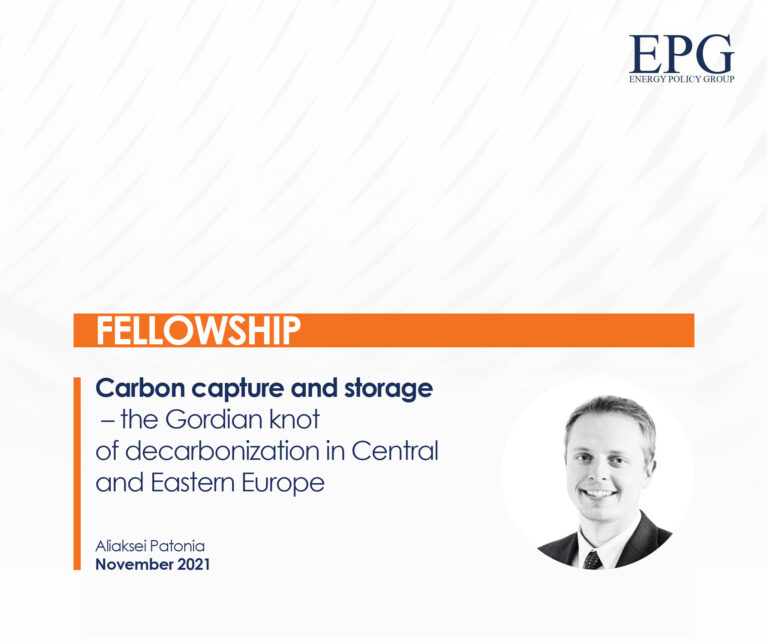
Carbon capture and storage (CCS) refers to a chain of technologies deployed to capture, transport and store CO2 away from the atmosphere, mitigating its warming effect on the climate. For each step in the CCS process, a range of technologies has been developed and tested for different industries and operating conditions, making CCS a complex value chain rather than a single, “off-the-shelf” technology as it is sometimes portrayed. Although there is still controversy surrounding it (given the fact that it could enable the continued burning of fossil fuels by capturing the emitted CO2), CCS is being progressively highlighted as unavoidable for industries where CO2 emissions cannot be abated, or are very difficult to reduce (for example, cement, steel, oil refining and chemicals production).
Against the backdrop of increasing interest in CCS in the European Union, given the bloc’s climate neutrality ambitions, the CCS4CEE project aims to reignite the discussion on CCS in Central and Eastern Europe (CEE). Compared to countries such as Norway and the Netherlands, where commercial CCS projects are being deployed, the discussion on CCS in the CEE region is far less advanced. On the other hand, given the reliance of their economies on fossil fuel use and manufacturing industries with hard-to-abate CO2 emissions, CEE countries may need to turn to CCS in order to balance the preservation of their high-value industries with their emissions reduction commitments.
The CCS4CEE project has evaluated the potential for CCS in 11 CEE countries , and will further develop roadmaps and capacity-building activities to accelerate the deployment of CCS in the region.
The CEE region is diverse, but its countries exhibit strong similarities in the profiles and trends of their CO2 emissions. Broadly, emissions have declined since 1990 due to the closure or modernization of industrial units, but remain disproportionately driven by the manufacturing industries and the significant use of fossil fuels (particularly coal) in energy production. So-called “process emissions” (emissions which result not from burning fossil fuels to supply energy, but rather from the very reactions and processes involved in the production of goods), are strikingly higher in some industries of CEE countries: cement production generates a higher share of national emissions than the EU average in most analysed countries, as does ammonia production and metallurgy in some (including Romania). Ukraine’s gargantuan steel industry, one of the few in the world that still uses open-hearth furnaces, generated 40.6 Mt of CO2 from process emissions alone in 2019 – equivalent to more than half of all process emissions from the metallurgical industry in the entire EU.
Dobrogea este locația privilegiată pentru primul ecosistem al hidrogenului din România, pentru că acesta ar putea fi produs, consumat de industrie și de comunități și stocat într-o aceeași regiune unde se întâlnește cererea cu oferta. Și există și posibilitatea exportului.
Dobogea este potrivită pentru aplicarea conceptului „Hydrogen Valley”, căci bifează trei factori cheie ca să devină un pol de dezvoltare a hidrogenului curat:
un potențial excepțional de producere a hidrogenului din energie regenerabilă onshore și offshore;
cerere regională de hidrogen din rafinării, combinate siderurgice și diferite sectoare de transport;
rolul strategic pe care îl poate juca Portul Constanța, potrivit unui comunicat al Energy Policy Group (EPG), emis în avanpremiera unui studiu privind elementele unei strategii pentru hidrogenul curat în România.
The Romanian region of Dobrogea has all the prerequisites for becoming a clean hydrogen valley:
an exceptional potential for producing hydrogen from onshore and offshore renewable energy
regional hydrogen demand in refineries, steel plants, and multiple transport modes
a strategic role that can be played by the Port of Constanța
These are the key factors that should turn Dobrogea into Romania’s flagship hydrogen initiative.
In the European Union’s pathway to climate neutrality, decarbonised molecules such as hydrogen will contribute to eliminating ‘stubborn emissions’ in hard-to-abate sectors – e.g., high-temperature heat and feedstock in industry, aviation and long-haul shipping, and potentially large-scale district heating and long-term electricity storage. This will increase the flexibility and resilience of the energy system, while entailing a massive growth of the hydrogen market. The European Commission’s 2020 Hydrogen Strategy sets an ambitious roadmap to install 6 GW of electrolysers by 2024 and 40 GW by 2030, with a clear focus on the development of renewable hydrogen capacities and electrolyser value-chains.
EPG’s upcoming study Clean Hydrogen in Romania: Elements of a Strategy estimates that in Romania more than 1.4 GW of electrolysers need to be installed to reach the Fit for 55 targets for clean hydrogen in industry and transport. Given the country’s renewable potential, it is estimated that clean hydrogen could be produced in Romania for less than €2.5/kgH2.
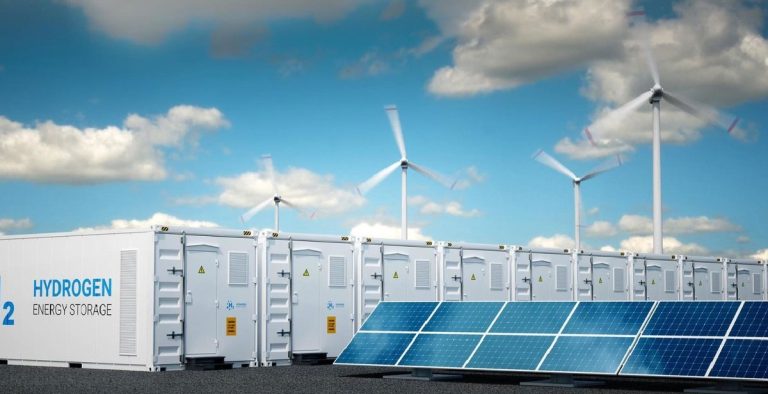
The European hydrogen strategy anticipates first deployments to take place in so-called ‘hydrogen valleys’ – i.e., locally integrated hydrogen ecosystems typically comprising multi-million-euro of investments across a defined geographic area. Ideally, such valleys cover a substantial part of the hydrogen value chain, from production, storage, and transport to use in sectors like industry, mobility, and energy. Dobrogea is a prime location for this concept, as hydrogen can be produced and used regionally, and co-locating production and demand reduces the additional costs associated with long-distance transport infrastructure.
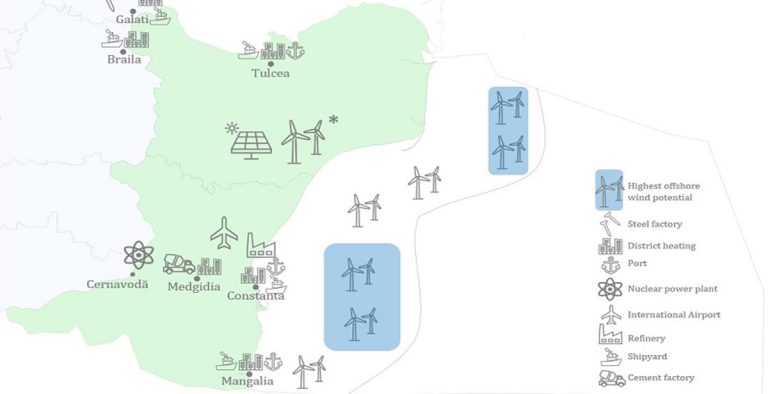
Indeed, Dobrogea is Romania’s renewable energy pole, offering the highest renewable energy potential, and hosting most of the country’s 3 GW of onshore wind capacities, which are expected to further expand both onshore and offshore. As shown by an EPG study, Romania has a significant offshore wind potential in the Black Sea, with an estimated total natural capacity of 94 GW, corresponding to 239 TWh of Annual Energy Production (AEP).
Moreover, the 1.4 GW of capacities from the Cernavodă nuclear power plant, also located in Dobrogea, are expected to be expanded by an additional two new reactors. All of this will happen in an area with limited local energy demand, leading to potential grid congestions. Transforming some of this decarbonised electricity in clean hydrogen could contribute to both alleviating the stress on the grid and further enabling the region’s decarbonisation.
Significant hydrogen demand can come from industry, especially the existing refinery (Petromidia), steel mill (Liberty Galați), and cement factory (LaFarge Medgidia), from district heating systems (Constanța, Galați, Tulcea, Brăila), and from transport – maritime (Ports of Constanța, Tulcea, and Mangalia) and aviation (Mihail Kogălniceanu International Airport).
The Port of Constanța can become the ideal gateway for hydrogen export. Indeed, it represents one of the most valuable assets for this endeavour. By synergising the offshore wind and hydrogen value chains, it could grow into a regional pole of decarbonisation for the entire Black Sea basin. The shipyards in Constanța, Mangalia, Tulcea, Braila or Galați can also contribute by building or retrofitting ships to run on clean hydrogen and hosting refuelling stations.
Turning the Dobrogea Hydrogen Valley into reality can bring great national benefits. According to the Commission’s Hydrogen Strategy, the hydrogen value chain will generate investments between €180 and €470 billion by 2050. Romania, particularly Dobrogea, can attract a considerable part of investments at EU level by 2030, which will total €24-42 billion for electrolysers, and €22-40 billion for renewable sources. Investments in hydrogen transportation, distribution, and storage in the EU will amount to a further €65 billion by 2030. The IEA estimates that 7.2 jobs are created for every million euros spent on the hydrogen production value chain.
To make this happen, the starting point should be the upcoming national hydrogen strategy, which should clearly set the objective of developing the Dobrogea Hydrogen Valley. This should be further bolstered through a national industrial decarbonisation strategy. The project can be developed in stages:
Initially, Dobrogea can become a local, medium-scale hydrogen valley, with focus on industry. Local clean hydrogen production projects may supply several industrial and potentially transport off-takers. The replacement of fossil-based hydrogen supply and other more carbon intensive industrial processes should be targeted first.
In the long term, by tapping into Romania’s cheap renewable energy potential, Dobrogea can develop into a larger-scale, international and export-driven hydrogen valley, with the Port of Constanța as its focal point.
Dobrogea este locația privilegiată pentru primul ecosistem al hidrogenului din România, pentru că acesta ar putea fi produs, consumat de industrie și de comunități și stocat într-o aceeași regiune unde se întâlnește cererea cu oferta. Și există și posibilitatea exportului.
Dobogea este potrivită pentru aplicarea conceptului „Hydrogen Valley”, căci bifează trei factori cheie ca să devină un pol de dezvoltare a hidrogenului curat:
un potențial excepțional de producere a hidrogenului din energie regenerabilă onshore și offshore;
cerere regională de hidrogen din rafinării, combinate siderurgice și diferite sectoare de transport;
rolul strategic pe care îl poate juca Portul Constanța, potrivit unui comunicat al Energy Policy Group (EPG), emis în avanpremiera unui studiu privind elementele unei strategii pentru hidrogenul curat în România.
“New normal” has become the buzzword of a world still reeling from the Covid-19 outbreak. But as it sought to break through the new normal of lockdowns and restrictions, the 25,000-strong COP26 gathering in Glasgow may have become the latest addition to the “new normal” of climate change negotiations: bold commitments that inspire hope, while their implementation plans ring hollow and seed doubt.
The Conference of Parties (COP), the flagship annual convention of the UN Framework Convention on Climate Change, has been an emotional rollercoaster since the 2015 Paris Agreement.
Expectations of COP26 were high to begin with – after a scrambled COP25, it came hot on the heels of urgent landmark reports on the climate crisis and was the first test for the Paris ‘ratchet’ ambition mechanism, whereby governments pledge emissions reductions through the submission of new National Determined Contributions (NDCs) prior to the conference. All this was doubled by an outstanding pressure from civil society for unprecedented and immediate action on climate change. And if world leaders had by any chance hit the snooze button on this fact, they were amply reminded of it in the opening ceremony by some of the world’s most well-known voices – and some of the most uncompromising about the continued dumping of emissions by industrial countries at the expense of those most vulnerable.
Nonetheless, from the stark reminders of the disastrous status of climate change, several big wins seemed to emerge for climate negotiators, as they ploughed through the interminable and controversial Article 6 of the Paris Agreement, which outlines how international emissions trading will work. Agreeing on Article 6 marked the end of negotiations drawn out since 2015, creating an accounting system capable of avoiding the double-counting of emissions reductions. The major accomplishment of the finalized Article 6 is that it enables linkages between separate emissions trading schemes, such as those currently operating in Europe, China, and some states in the US.
In other positive news, 197 countries pledged to strengthen the 2030 targets of their NDCs. The final 11-page COP26 agreement, named the Glasgow Climate Pact, established that greenhouse gas emissions must be reduced by at least 45% by 2030 relative to 2010 levels, to have a high chance of maintaining global average temperature increases under 1.5°C. Aside from the formal negotiations, a plethora of side deals, agreements, and initiatives – a common practice at COPs – also delivered game-changing commitments. Multiple collective statements were put forward on some of the most pressing climate-related issues, including reducing coal-fired power, cutting methane emissions, and halting deforestation.
A “death knell for coal power” – or at least a Do Not Resuscitate order
A series of “confusing’’ new and existing commitments on coal were made during COP26. A few media blunders caused by UK diplomatic staff ended in watered-down ambitions on coal power: from initial ambitions to “phase-out” coal, to the final official text presenting a rather timid “phase-down,” following a late intervention by China and India. Nevertheless, UK prime minister Boris Johnson was right to label the deal a “game-changing agreement” which sounds “the death knell for coal power.” Despite the eleventh-hour damping down of ambitions on coal phase-out, the Glasgow Climate Pact remains the only COP agreement to include a pledge to reduce unabated coal use, a historic agreement between nearly 200 countries.
Significant advances on eliminating coal were also announced in parallel to the formal COP negotiations. Signatories of the Global Coal to Clean Power Transition Statement committed to scaling up clean power and energy efficiency, phasing out coal and curbing new unabated coal power, all while ensuring a just transition. The statement was signed by three of the world’s largest coal users (South Korea, Indonesia, and Vietnam), as well as several of Europe’s main coal power producers including Germany, Poland, and Ukraine. On the eve of COP26, a landmark agreement was reached by G20 countries, including China, to stop international financing of coal power. This is a monumental shift that cannot be overstated: over 40GW worth of ongoing projects in 20 countries relied on Chinese finance alone. Other side-deals at COP26 committed to mobilize financing for coal phase-out, such as the $8.5 billion Just Transition Partnership for South Africa, where France, Germany, the UK, the US and the EU pledged to supporting the country to phasing out coal power.
Notwithstanding the failure to formalize a clear global coal phase-out and the patchwork of announcements with varying degrees of ambition, COP26 has de facto cosigned the end of coal. This had already been underway for some time. In the run-up to the COP21, when the Paris Agreement was signed, Bangladesh, Pakistan, Sri Lanka, and 40 other countries announced they would not build any new coal. And since the negotiation of the Paris Agreement, there has been a 76% reduction in proposed coal power projects, including the cancellation of more than three quarters of planned projects in China, which accounts for more than half of the global pre-construction pipeline. Morocco, the Ivory Coast, and Poland had a single remaining project in development – all now expected to be cancelled – and Egypt will also stop building new coal-fired power plants.
Thus, at COP26, no-new-coal officially became the norm. More than 60 countries pledged to not build new coal power plants, and there is no space for new coal in Indonesia and Vietnam’s net-zero targets, nor in India’s new 2030 NDC. The Just Energy Transition Partnership for South Africa is a praiseworthy effort to eliminate coal power while maintaining a just transition for workers and communities. Based on these developments, the global focus will now shift from agreeing on a coal phaseout to negotiating the pace at which it will be achieved.
It’s not all about carbon dioxide – spotlight on methane emissions
In possibly one of the most talked-about agreements at COP26, 109 countries pledged to reduce their methane emissions by 30% until 2030 and to use the best available inventory methodologies for quantifying emissions. Methane is a potent greenhouse gas, with a warming potential 80 times higher than carbon dioxide. Methane leakages (“fugitive emissions”) occur across the entire gas value chain, from both unintentional (e.g. during extraction or in low pressure distribution systems that still use cast iron pipes) and purposeful sources (e.g. when gas is vented rather than flared). The agreement was jointly announced by the EU and the US in September and formalized during COP26, signed by countries responsible for more than half of current global methane emissions, including Indonesia, Canada, Brazil, and the UK. The agreement fell short of a breakthrough, as some of the largest methane emitters, namely Australia, China, and India, did not sign up. Nonetheless, China has already agreed to meet with US officials in early 2022 to discuss the specifics of this agreement, as pressure mounts to eliminate fugitive methane emissions globally.
An unprecedented breakthrough agreement for industrial decarbonization
The Glasgow conference also marked the first COP where industrial decarbonization was specifically discussed, marking a shift from general headline targets towards more concrete pledges for the actual implementation of climate commitments. The steel breakthrough agreement brings together over 30% of the global steel production. A long list of countries, including the EU, UK, US, Egypt, South Korea, Turkey, Japan, and India agreed ‘’to make near-zero emissions steel the preferred choice by 2030’’. This is an unprecedented step forward for the global industrial transition – one of the tougher nuts of decarbonization to crack.
Emissions from steel production are the largest of any industry (around 7% of total GHG emissions) and equally among the hardest to abate. However, the notable absentee from the agreement is China, the world’s largest steel producer, evidencing that further diplomatic efforts are needed for broader participation in this agreement. Market pressures are also likely to unfold: as decarbonized steel will become increasingly available on international markets, other countries are expected to follow suit, especially given that India, one of the fastest-growing steel producers, is among the signatories of the COP26 steel agreement.
Ending deforestation – this time, with more money
COP26 also saw a globally significant commitment on deforestation. 100 countries, whose territories contain 85% of the world’s forests, pledged to stop deforestation by 2030. This is not the first global agreement on deforestation (though previous ones have had vastly underwhelming impacts), but it is better funded: the pledge includes public and private funds amounting to over €16 billion, some of which will go to developing countries to restore damaged land, tackle wildfires, and support local communities. Brazil, which houses most of the vast Amazon rainforest, is among the signatories, and a €1.3 billion fund has been established to protect the world’s second-largest tropical rainforest in the Congo Basin. 28 countries have also pledged to remove deforestation from the global food trade, and some of the world’s largest financial companies have promised to end investment in activities linked to deforestation.
Now what?
All in all, the outcome of COP26 was a concert of promises in a relatively hopeful key, despite some countries striking a discordant note or missing a beat. However, an awkward quasi-silence falls after the applause, when the inevitable question of how all this will be implemented arises. True, concrete implementation agreements for industrial decarbonization have been agreed, and this is a hugely positive step. But how will the global pledge on deforestation be monitored? Even more basically, how do you define deforestation? Just days after Indonesia signed the deforestation pledge, its officials called it “unfair”, saying among other things that there are multiple ways to define deforestation. What is the actual coverage of ending coal investments? In addition to the toned-down language around coal use in the Glasgow Climate Pact, the G20 agreement to stop international financing of overseas coal covers only a fraction of public financing for this dirtiest fossil fuel, and does not address the private sector. Of course, this pledge will have an impact – removing more than 40GW of coal power projects is no small feat – but celebrating this massive achievement should not fail to underscore what more needs to be done.
To solve the climate crisis, finance is key. Funding the transition towards a sustainable global economy has long been the subject of climate negotiations, and this year was no different: the Glasgow Climate Pact emphasizes the need for high- and middle-income countries to support developing countries with financing to the tune of over $100 bn/y (after failing to deliver on their original promise to mobilize $100 bn/y by 2020). Disappointingly, the lack of agreement on compensation for the most climate-vulnerable countries may have represented the largest failure of COP26. The negotiations for the ‘’Glasgow Loss and Damage Facility,’’ a financial mechanism for responding to the unavoidable impact of climate change that cannot be adapted to, collapsed. This recent foundering in creating an insurance mechanism for countries affected by climate damage (the result of emissions which they did not generate) means that the uneven impact of climate change will still strike the hardest in the most vulnerable regions.
It should be mentioned that some finance has been mobilized, such as the Just Transition Partnership for South Africa – and not just public finance: the private sector is key to implementing climate ambitions, given that they require such a phenomenal and increasing amount of money. Earlier this year, the Glasgow Financial Alliance for Net Zero (GFANZ) was launched as a centralized forum bringing together sustainable finance initiatives into a 450+ company group holding $130 trillion in assets – which they have committed to the net-zero transition. However, these initiatives are no exception from the question of how they will be policed. Critics say that without certainty in governmental support (for example, in phasing out fossil fuels), the GFANZ may become yet another PR exercise. And without a global carbon price and details of how exactly the financial sector will shift market risk towards carbon-intensive technologies, these ambitious commitments of the private sector may end up under the same banner of “great idea, questionable execution.”
The bottom line – see you next year
The road to net-zero is bound to be strenuous when nearly 200 countries need to agree on essentially reshaping their economies – particularly those who have only just found their seat at the table. COP26 is Exhibit Z – two weeks of wrangling in official and off-the-record negotiations to shift the world a bit closer to the sustainable future we all know is possible. And shift the world it did – first-of-their-kind global deals on reducing coal use, halting deforestation, and cutting methane emissions – incredible feats in themselves. But as always, it is down to the “boring” topics that are usually missing in inspirational speeches: financing, monitoring, evaluation, implementation, management. As is the case with COP, the world will have to wait – at most until the Global Stocktake in 2023, where an assessment of the actual delivery of commitments under the Paris Agreement will take place. Until then, the achievements of COP26 are indeed noteworthy – but the hope they breed will only last as long as leaders keep them in focus, implementation and all. Hopefully, until COP27 at least.
Carbon capture and storage (CCS) refers to a chain of technologies deployed to capture, transport and store CO2 away from the atmosphere, mitigating its warming effect on the climate.
For each step in the CCS process, a range of technologies has been developed and tested for different industries and operating conditions, making CCS a complex value chain rather than a single, “off-the-shelf” technology as it is sometimes portrayed.
Although there is still controversy surrounding it (given the fact that it could enable the continued burning of fossil fuels by capturing the emitted CO2), CCS is being progressively highlighted as unavoidable for industries where CO2 emissions cannot be abated, or are very difficult to reduce (for example, cement, steel, oil refining and chemicals production).
Against the backdrop of increasing interest in CCS in the European Union, given the bloc’s climate neutrality ambitions, the CCS4CEE project aims to reignite the discussion on CCS in Central and Eastern Europe (CEE).
Compared to countries such as Norway and the Netherlands, where commercial CCS projects are being deployed, the discussion on CCS in the CEE region is far less advanced. On the other hand, given the reliance of their economies on fossil fuel use and manufacturing industries with hard-to-abate CO2 emissions, CEE countries may need to turn to CCS in order to balance the preservation of their high-value industries with their emissions reduction commitments. The CCS4CEE project has evaluated the potential for CCS in 11 CEE countries, and will further develop roadmaps and capacity-building activities to accelerate the deployment of CCS in the region.
The CEE region is diverse, but its countries exhibit strong similarities in the profiles and trends of their CO2 emissions. Broadly, emissions have declined since 1990 due to the closure or modernization of industrial units, but remain disproportionately driven by the manufacturing industries and the significant use of fossil fuels (particularly coal) in energy production.
So-called “process emissions” (emissions which result not from burning fossil fuels to supply energy, but rather from the very reactions and processes involved in the production of goods), are strikingly higher in some industries of CEE countries: cement production generates a higher share of national emissions than the EU average in most analysed countries, as does ammonia production and metallurgy in some (including Romania).
Ukraine’s gargantuan steel industry, one of the few in the world that still uses open-hearth furnaces, generated 40.6 Mt of CO2 from process emissions alone in 2019 – equivalent to more than half of all process emissions from the metallurgical industry in the entire EU.
*Aliaksei Patonia is an EPG Fellow. The views expressed in this paper are those of the author and do not necessarily reflect the opinions of EPG.
Creșterile fără precedent ale prețurilor energiei din ultimele luni au generat discuții aprinse despre cauze, designul pieței de energie electrică, prețul carbonului și dependența de importurile de gaze naturale.
Răspunsul formulat până acum de legiuitori pentru rezolvarea acestor probleme (în principal, plafonări de prețuri și subvenții) nu oferă decât soluții de avarie, de termen scurt, care nu rezolvă disfuncționalitățile structurale ce pot duce la repetarea unor astfel de situații.
Pentru a putea cu adevărat să participe la dialogul global între statele cu nivel ridicat de dezvoltare, România trebuie să devină un participant mai activ, mai informat și mai asumat privind măsurile de combatere a schimbărilor climatice. De altfel, OCDE a lansat deja în 2021 o platformă dedicată pentru monitorizarea, evaluarea,
În plus, măsurile luate de autoritățile din România pentru contracararea efectelor crizei actuale a prețurilor energiei asupra consumatorilor surprind prin direcția opusă față de propunerile Comisiei Europene în toolbox-ul recent publicat. Decizia de a suprataxa cu 80% veniturile ce depășesc 450 lei/MWh, ce se aplică doar producătorilor de energie curată, fără a ține cont de specificul de operare în piață a surselor regenerabile, periclitează nu doar investițiile existente, ci mai ales noile dezvoltări de capacități de generare ieftine și cu timp de instalare rapid, ce reprezintă, de altfel, singura soluția pentru a evita astfel de crize în anii următori. Pseudo-argumentarea că acest tratament fiscal discriminatoriu s-ar justifica prin faptul că producția de energie electrică pe bază de combustibili fosili este „deja împovărată” prin plata certificatelor de emisii de carbon denotă atât neînțelegerea rostului acestor certificate, cât și lipsa oricărei preocupări reale de decarbonare a sistemului energetic românesc.
Blocarea și întârzierea investițiilor în surse regenerabile, în special solare și eoliene, vor cauza prețuri mai mari ale energiei electrice și ale certificatelor de carbon, vor crește dependența de importurile de gaze și, mai ales, vor periclita atingerea obiectivelor climatice de reducere a emisiilor, după cum arată, printre altele, un raport publicat recent de Aurora Research. Înainte de a explica mai aprofundat aceste riscuri, este necesară clarificarea principalelor cauze ale crizei actuale și corectarea unor explicații eronate care au fost lansate în spațiul public.
Putem blama prețul certificatelor de carbon?
Având în vedere aproape dublarea prețului certificatelor de dioxid de carbon de la aproximativ 34 €/tCO2e la începutul anului 2021 la peste 60 €/tCO2e în prezent, schema UE de comercializare a certificatelor de emisii (ETS) a fost imediat blamată pentru creșterea prețurilor electricității.
Mecanismul ETS limitează volumul de gaze cu efect de seră care poate fi emis de industria energointensivă, de către producătorii de energie și de companiile aeriene. Producătorii de energie electrică trebuie să cumpere un certificat EUA pentru fiecare tonă emisă de CO2. Totalul certificatelor disponibile este plafonat la un nivel stabilit pentru UE. Acest plafon este redus anual, ajungând în cele din urmă la zero. Pe măsură ce volumul certificatelor scade, acestea vor deveni tot mai dificil de achiziționat de către companiile ce produc energie electrică cu un nivel ridicat de emisii per MWh. Astfel, cu timpul, implementarea schemei ETS va determina reducerea orelor de operare a centralelor pe combustibili fosili, precum lignitul, huila, dar și gazele naturale.
Potrivit propunerilor legislative din pachetului Fit-for-55 din această vară, plafonul urmează să fie ajustat pentru a asigura o reducere a emisiilor de carbon din sectoarele acoperite de ETS cu 61% până în 2030 față de 1990. Acest anunț, împreună cu sporirea cererii pentru certificate EUA ca urmare a creșterii consumului de energie electrică în timpul revenirii economice din 2021, au dus la prețuri fără precedent pentru certificatele de carbon. Totuși, prețul certificatelor EUA nu a contribuit cu mai mult de o cincime la scumpirea curentă a electricității, conform estimărilor Comisiei Europene. Mai degrabă, problemele de aprovizionare cu gaze și prețul acestora la nivel internațional, precum și unele deficiențe structurale în funcționarea piețelor de energie electrică au contribuit decisiv la o creștere concertată a prețurilor energiei electrice în întreaga UE.
O criză națională sau globală? Prețul gazelor naturale
Prețul gazelor naturale a avut o creștere fulminantă în 2021. Pe platforma olandeză TTF Gas Futures, de referință în Europa, gazele erau comercializate la 88 €/MWh la sfârșitul lunii octombrie, față de 16 €/MWh la începutul anului. Motivele pentru această evoluție constau într-o combinație între creșterea cererii la nivel mondial, ca urmare a accelerării recuperării economice, mai ales în Asia, și a problemelor UE de aprovizionare cu gaze din Rusia și Norvegia. Efectul a fost exacerbat de o vară cu producție scăzută a turbinelor eoliene și o primăvară rece, care au dus la golirea rezervelor de gaze naturale – concomitent cu reticența companiilor de a investi la timp în stocuri de gaze, care cauzaseră costuri mari cu un an mai devreme.
Actuala criză arată riscurile asociate cu dependența UE de importurile de combustibili fosili, în special gaze naturale, și expunerea piețelor europene la volatilitatea prețurilor combustibililor fosili. Acest fenomen este responsabil și de creșterea prețului energiei electrice la nivel european, afectând toate statele membre. Designul piețelor en-gros de energie electrică și cuplarea lor regională creează condițiile structurale prin care volatilitatea prețurilor gazelor naturale la nivel global afectează prețul energiei electrice inclusiv în România.
Cum au contribuit designul piețelor pentru energie electrică și deficitul de capacitate la exacerbarea crizei?
Designul pieței pentru ziua următoare (PZU) folosit pe plan european, inclusiv în România, este construit în jurul mecanismului costului marginal. Acesta prevede ca prețul pe piața de energie electrică să fie stabilit de oferta producătorului a cărui producție este necesară pentru a atinge nivelul cererii de energie electrică din piață. De obicei costul marginal este dat de producătorii pe bază de combustibili fosili, iar în situația actuală în care cotația gazelor a atins un nivel istoric, producătorul marginal este cel care folosește acest combustibil, cel mai scump.
Dacă România ar dispune de o capacitate regenerabilă instalată mai mare, am observa o scădere a presiunii în piață și o reducere a prețului energiei electrice în momentele în care resursa regenerabilă este disponibilă. Astfel ar putea fi acoperit și deficitul curent de capacitate. În ultimii ani, România s-a transformat dintr-un exportator net de energie electrică într-un importator. Conform Transelectrica, în 2020 importurile au însumat 6,8 TWh iar exporturile 4 TWh, rezultând o balanță negativă de 2,8 TWh raportată la consumul final total de energie electrică de 55,7 TWh. Deficitul evident de capacitate este explicat prin retragerea unităților pe combustibili fosili, în special cărbune, ce și-au atins durata de viață, dar și prin lipsa de investiții în noi capacități de generare. Singura investiție în curs în centrale convenționale, proiectul CCGT de 430 MW de la Iernut, a fost din nou amânată după ce termenul inițial de punere în funcțiune (2019) a fost cu mult depășit.
Ultimele surse regenerabile au devenit operaționale în 2016, iar de atunci investițiile în acest sector au fost practic blocate, deși între timp energia eoliană și cea fotovoltaică au devenit cele mai ieftine modalități de producere a energiei electrice. Principalele cauze ale înghețării investițiilor sunt lipsa unui cadru legislativ și de reglementare predictibil, capacitatea limitată a rețelei de transport de a prelua noi capacități și accesul dificil la aceasta.
Conform Planului Național Integrat în domeniul Energiei și Schimbărilor Climatice (PNIESC), România va trebui să își crească producția din surse regenerabile de la aproximativ 3 GW instalați în energie eoliană la 5,25 GW, respectiv de la 1,4 GW instalați în energie solară la 5 GW în 2030. În același timp, propunerile din pachetul Fit-for-55 ar necesita un total de 7 GW instalați în energie eoliană și 7 GW în energie solară, ceea ce însemnă un necesar de proiecte de investiții de 10 GW până în 2030. Acestea sunt necesare având în vedere creșterea anticipată a cererii de electricitate cu 15%, până la 62 TWh în 2030, rezultată din electrificarea parțială a transportului rutier și a încălzirii clădirilor, precum și din creșterea economică prognozată, conform studiului Aurora. Cifra de 10 GW nu include investițiile necesare pentru înlocuirea sau prelungirea duratei de viață a surselor regenerabile existente, a căror menținere este imperativă pentru atingerea țintelor, fiind în sarcina producătorilor afectați de măsura de suprataxare impusă de decidenți.
Blocarea investițiilor în energie regenerabilă poate cauza crize similare în viitor
După cum arată Aurora, un ritm lent de instalare a noilor surse de energie regenerabilă și o eliminare întârziată a cărbunelui din mixul energetic ar duce la scumpiri semnificative a prețului energiei electrice tranzacționate en-gros, cât și a valorii certificatelor EUA până în 2030. Cele mai serioase consecințe ar fi agravarea sărăciei energetice, în special prin creșterea facturii la consumatorii casnici, reducerea competitivității sectorului industrial european și adâncirea dependenței de importurile de gaze, ceea ce ar mări expunerea pieței de energie electrică la volatilitatea a prețului combustibililor fosili.
Astfel, dacă barierele care stau în calea dezvoltării parcurilor solare și eoliene de producție a energiei electrice nu vor fi eliminate, se poate ajunge la un preț al certificatelor EUA cu 80% mai mare comparativ cu un scenariu în care aceste probleme sunt rezolvate. La acest fenomen poate contribui și prelungirea artificială a duratei de viață a centralelor pe cărbune. În cazul României, acești factori ar putea cauza o creștere de 50% a prețului electricității față de prețurile din vara acestui an (înainte de problemele de aprovizionare cu gaze). Pe de altă parte, dacă România va dezvolta capacități regenerabile la nivelul țintelor propuse de Comisie, previziunea de creștere a prețului este doar 8% până în 2030, cu o tendință negativă spre finalul intervalului. Atingerea acestui obiectiv presupune o capacitate totală instalată a regenerabilelor de 14 GW în 2030, ce ar acoperi 69% din producția de energie electrică. De asemenea, pe baza criteriilor de rentabilitate economică, doar 500 MW de capacități pe bază de lignit ar mai fi funcționale peste nouă ani.
Schema ETS asigură condițiile necesare atingerii țintelor de decarbonare pe termen lung, dar nu poate elimina riscurile pe termen scurt și mediu. Perioada de viață a instalațiilor cu emisii intensive de CO2 poate fi prelungită dincolo de rentabilitatea lor economică prin ajutor financiar sau alte facilități acordate de stat. Acest lucru trebuie evitat. Impunerea unui calendar de eliminare a cărbunelui, precum cel propus în PNRR, este o măsură potrivită în acest sens. Dar există riscul ca dezvoltarea surselor de energie regenerabilă să nu fie sincronizată cu eliminarea capacităților fosile. În ciuda țintelor europene pentru regenerabile, ritmul punerii în funcțiune al unor noi capacități s-a prăbușit în ultimii ani în România.
Principalele probleme care trebuie rezolvate
Barierele din calea dezvoltării surselor regenerabile țin mai degrabă de natură administrativă și de reglementare (de exemplu, lipsa instrumentelor de reducere a riscului investițional), decât de lipsa resurselor financiare. Acest fapt este confirmat de apetitul investitorilor, dat fiind că proiecte însumând între 20 și 30 GW de energie regenerabilă sunt în dezvoltare în acest moment.
Autoritățile trebuie să clarifice prin lege posibilitatea semnării contractelor de vânzare a energiei pe termen lung de tip PPA (Power Purchase Agreement), în timp ce introducerea unui instrument de tip CfD (Contracts for Difference) este așteptată pentru finalul anului 2022. Ambele sunt importante pentru reducerea riscului investițional, dată fiind nevoia României de a recupera încrederea investitorilor după desele schimbări legislative din ultimul deceniu. Aceste două instrumente ar fi putut deja ajuta România în situația actuală a sectorul energetic, dacă ar fi fost deja în vigoare. PPA-urile ar fi permis ca o mai mare parte din energie să fie tranzacționată pe termen lung și nu pe PZU, unde volatilitatea atinge cote extrem de ridicate în aceste zile. Folosirea CfD-ului pentru capacități regenerabile ar fi eliminat nevoia de suprataxare, producătorii din acest sector plătind înapoi diferența dintre prețul de exercitare și prețul de vânzare a energiei.
O altă barieră legală pentru dezvoltarea noilor capacități regenerabile este legea fondului funciar, care îi pune pe investitori în imposibilitatea de a achiziționa sau de a securiza terenuri extravilane. Acest aspect a dus la blocarea de facto a oricărei investiții în proiecte energetice regenerabile localizate extravilan.
Apoi, din punct de vedere tehnic, capacitatea rețelei de transport de a conecta și integra noi capacități regenerabile este limitată, iar viteza cu care Transelectrica dezvoltă noi proiecte nu permite ritmul necesar de dezvoltare pentru atingerea țintelor. Dincolo de limitările tehnice, costurile de racordare la rețea depășesc în anumite cazuri 10% din costul total de instalare a capacităților regenerabile.
Piața de echilibrare este, în continuare, o barieră majoră pentru investitorii în regenerabile. Modificările aduse pentru conformarea la regulamentele UE nu au contribuit la o reducere a costurilor cu dezechilibrele, acestea rămânând la un nivel foarte ridicat comparativ cu alte piețe din Europa. Situația se datorează în special lipsei de concurență, iar deblocarea investițiilor în capacități de stocare și soluții de demand side management ar ajuta la reducerea gradului de concentrare a pieței, precum și la îmbunătățirea adecvanței sistemului energetic.
Pe lângă capitalul privat ce poate fi atras de sectorul energiei regenerabile, România dispune de fonduri considerabile prin mecanismele europene de finanțare, dintre care peste 10 miliarde de euro numai prin Fondul de Modernizare. Cu toate acestea, întârzierile în implementarea unui mecanism național competitiv și transparent de selecție a proiectelor, împreună cu celelalte bariere menționate fac ca niciun proiect regenerabil de mari dimensiuni să fie astăzi aproape de punerea în funcțiune în România.
Este îmbucurătoare orientarea anumitor dezvoltatori din România către proiecte integrate, cu sisteme de stocare incluse, ce pot rezolva nu doar deficitul de capacitate de generare, ci într-o anumită măsură și provocările legate de adecvanță. Este necesar ca primul apel de proiecte al Fondului pentru Modernizare să permită și finanțarea unor proiecte integrate.
Abordarea acestor probleme și deblocarea investițiilor în energie regenerabilă va reduce expunerea României la crize energetice, similare cu cea actuală. Acestea trebuie, desigur, combinate cu măsuri pe termen scurt pentru reducerea presiunii financiare exercitate în special asupra consumatorilor vulnerabili.
Maritime shipping is the backbone of the international economy, accounting for more than 90% of world trade.[1] This critical economic weight has recently been illustrated by the Suez Canal blockade of March 2021, which caused major supply chain disruptions on a global scale.[2]
This role in the economy is as significant as its environmental impact: maritime shipping is responsible for 2.5% to 3% of global greenhouse gas emissions. This is comparable to the contribution of Germany, is alarming both in its current level as well as in its forecasted growth. According to the International Maritime Organization (IMO), at current rates, the sector’s emissions could rise to 90-130% in 2050 compared to 2005.[3]
In addition to contributing to global warming, one of the main issues associated with maritime shipping is its contribution to local air pollution in port cities. Conventional heavy fuel used by a large majority of the global shipping fleet emits numerous harmful particles (sulphur dioxide, nitrogen dioxide, fine particles, etc.).[4] Despite the strengthening of regulations regarding these local emissions at local and international levels, scientific literature estimates the number of premature deaths in 2020 linked to pollution from the shipping industry between 212,300 and 595,400.[5]
Notwithstanding multiple efforts in the past decade by industry and regulatory bodies, the shipping industry’s environmental impact remains a major challenge. Despite the global pandemic of 2020, shipping demand has remained high on a global level and is set to keep growing at a slow but steady rate of 2-3% annually in the coming years. Moreover, logistical congestion in the industry leads carriers to require significant increases in their fleets’ size and tonnage.[6] Thus, the question poses itself, is the maritime shipping industry on the right course towards decarbonization, and are current efforts and initiatives in line with the Paris Agreement?
First and foremost, the shipping industry and its global governing body, the IMO, have taken steps to tackle the environmental challenges linked to its flourishing activities. The sector has made significant efforts to reduce its environmental footprint, notably by overcoming the sector’s inherent decentralized nature through global initiatives, heavily limiting the effects of local efforts or legislation. Since 1997, the IMO has been mandated by its members to control the sector’s greenhouse gas emissions, resulting in a number of resolutions on emissions, energy efficiency and data collection efforts. In 2018, the organization adopted its “Initial strategy on the reduction of greenhouse gas emissions from ships,” aiming for a reduction of emissions of 40% by 2030 compared to 2008[7]. This strategy is set to be revised by 2023, setting new standards aiming for a complete decarbonization of shipping as soon as possible in the 21st century.[8] Local pollutants are not exempt from the IMO’s efforts: in January 2020, a global “sulphur cap” came into force, limiting the sulphur content of fuels used by the shipping industry to 0.5%.
This global take on emissions has long been complemented by local policies. The EU has been a leader in this respect, setting a 0.1% sulphur emission control area in all ports and in multiple other areas of the territorial waters of its Member States. Emissions reporting requirements are also enforced, as well as incentives for ports to deploy the infrastructure necessary to welcome the waste waters of ships equipped with exhaust gas cleaning systems.[9] Finally, market players have deployed numerous voluntary initiatives aimed at further reducing the emissions of their fleets. Such initiatives include the development of liquified natural gas, biofuels, ammonia and hydrogen as shipping fuels, improved energy efficiency of ships, carbon offsetting and wind sails.[10][11][12]
While the initiatives and regulations mentioned above are relevant contribution in limiting the shipping industry’s emissions, these remain largely insufficient – if not counterproductive in some cases – to set this thriving economic sector in line with the objectives of the Paris Agreement. Indeed, some solutions embraced by the industry as silver bullets for their environmental impact could end up worsening an already dire situation. For instance, one of the main solutions considered to reduce the carbon emissions of ships is the uptake of LNG to replace heavy oil. But as natural gas is associated with significantly lower carbon emissions than oil, it remains a carbon intensive fossil fuel. Moreover, gas extraction is currently accompanied by significant methane leaks, which has a worse contribution to climate change than CO2.[13]
Hydrogen and one of its by-products, ammonia, also fall into the category of promising solutions needing to be carefully managed to improve the sector’s environmental impact. Both kinds of molecules can power ships by combustion or by producing electricity through a fuel cell, effectively replacing hydrocarbons. However, the production of these molecules is either associated with a very low roundtrip efficiency when produced from renewable electricity, or a heavy environmental footprint when produced from natural gas.[14]
Beyond the current lack of swift and effective solutions to decarbonize the shipping sector, the investment cycles inherent to the industry are also a major barrier to the generalization of the most effective solution available. Currently, despite efficiency gains being considered in the latest designs, ships fuelled by heavy oil remain the norm in shipyards around the world. This becomes a pressing issue when considering that a ship’s average lifespan is 25 years, and multiple supplementary years can go by between the designing and building processes of ships. Even if a paradigm-changing solution was found to decarbonize the sector’s emissions, a full investment cycle would need to go by before it could fulfil its potential[15].
Presently, the shipping sector is at a major crossroads. The aggregation of mature decarbonization solutions (energy efficiency, reinforced legislation against the heaviest polluting fuels, etc) and extensive research and development into more prospective alternatives (ammonia, green hydrogen, etc) could theoretically put this key link in our globalized world in line with the Paris Agreement and, on the longer term, lead the way towards complete decarbonization. However, this would require a significant throttling up of investments in clean solutions from market players. A recent study by the University Maritime Advisory Services and Energy Transitions Commission estimated the scale of investments needed for the complete decarbonization of shipping at close to $2 trillion over 20 years, a figure exceeding the $1.8 trillion global energy investments in 2018.[16] Should the sector fail to deploy such efforts, emissions at current rates could see a 50% increase by 2050 compared to 2018.[17]
The challenge the shipping industry faces is great, but solving it remains within reach. Growing policy initiatives of local and global scales imposing stronger sanctions and restrictions vis-à-vis the most polluting technologies will ultimately make significant investments from shipowners in energy efficiency and decarbonized fuels a necessity. Such policy options include carbon pricing schemes, supporting the deployment of electric grid connections at quays to avoid emissions when ships are in port-by-port authorities, and gradually banning certain fuels from using port infrastructure. Limiting the financial opportunity to invest in polluting maritime transport solutions through investment taxonomies could also prove to be a significant incentive to shipowners to decarbonize their fleets. Private initiatives such as the Poseidon Principles could be of similar efficiency if reinforced to be in line with the Paris Agreement.[18]
Utilizăm cookie-uri pentru a optimiza experiența de navigare și pentru a analiza traficul site-ului. În timp ce cookie-urile strict necesare sunt active permanent pentru a asigura funcționarea paginii, avem nevoie de consimțământul dumneavoastră pentru cookie-urile de analiză și marketing. Află mai multe: Politica de cookies / Politica de confidențialitate.
Funţionalităţi
Always active
"Stocarea tehnică sau accesul sunt strict necesare pentru scopul legitim de a permite utilizarea unui serviciu specific solicitat explicit de către abonat sau utilizator, sau pentru scopul unic de a efectua transmiterea unei comunicări printr-o rețea de comunicații electronice.
Preferinţe
Stocarea tehnică sau accesul sunt necesare pentru scopul legitim de a stoca preferințele care nu sunt solicitate de abonat sau utilizator.
Statistici
Stocarea tehnică sau accesul sunt folosite exclusiv pentru scopuri statistice.The technical storage or access that is used exclusively for anonymous statistical purposes. Without a subpoena, voluntary compliance on the part of your Internet Service Provider, or additional records from a third party, information stored or retrieved for this purpose alone cannot usually be used to identify you.
Marketing
Stocarea tehnică sau accesul sunt necesare pentru crearea de profiluri de utilizator pentru a trimite publicitate sau pentru a urmări utilizatorul pe un site web sau pe mai multe site-uri.