
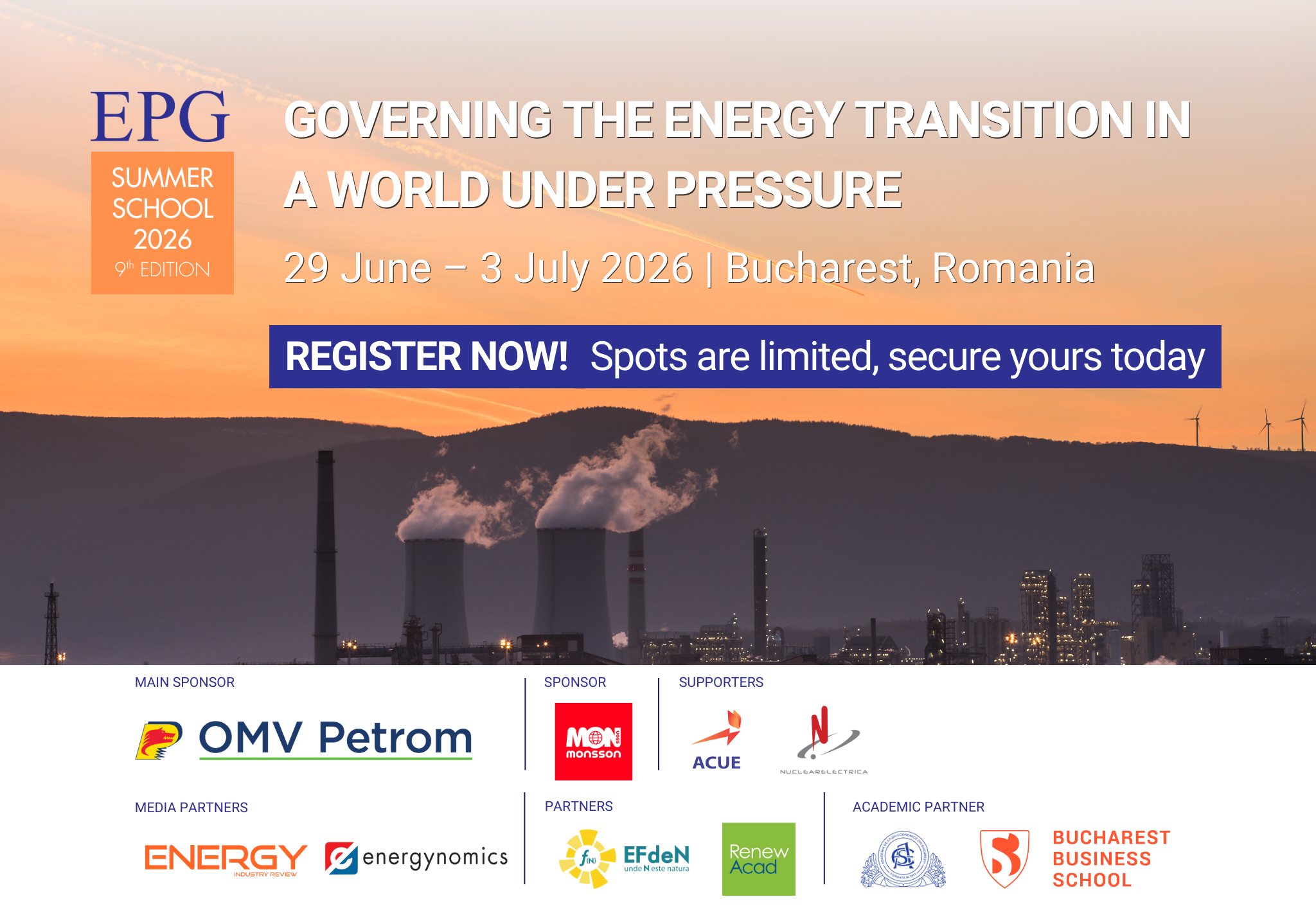
EPG Summer School 2026
(9th edition)
“Governing the Energy Transition in a World under Pressure”
Programme description
In a rapidly changing geopolitical, economic, and technological context, delivering the energy transition has become as important and challenging as designing ambitious policies. The EPG Summer School 2026 focuses on how energy transitions can be governed and implemented in a world under pressure, marked by geopolitical tensions, economic constraints, and shifting political priorities, while striving to maintain system resilience, energy security, and affordability.
Over an intensive 5-day programme, the summer school offers an in-depth understanding of the structural challenges faced by today’s energy systems and the trade-offs involved in pursuing climate and energy objectives. Through lectures, interactive workshops, and site visits, participants engage with leading policymakers, researchers, and practitioners from international organisations, academia, and the energy industry.
The programme explores how energy and climate governance, energy system transformation, and the shift towards a clean and competitive economy intersect in practice. Particular attention is given to system flexibility, digitalisation, storage, grid development, industrial decarbonisation, and the evolving role of nuclear energy, alongside cross-cutting issues such as energy security, just transition, global supply chains, and policy uncertainty.
The summer school is designed for 20–25 Master’s and PhD students, as well as young professionals (up to 35 years old) working or studying in energy, climate policy, economics, engineering, law, political science, environmental studies, international relations, and related fields. Ideal candidates include professionals from public institutions, international organisations, NGOs, think tanks, academia, and the private sector.
Beyond its academic content, the EPG Summer School provides a unique platform for peer-to-peer learning, debate, and community building, fostering cross-disciplinary and cross-border collaboration among the next generation of energy and climate leaders navigating the realities of the energy transition.
Programme structure
The summer school builds upon the thematic areas and projects EPG is undergoing, structured along 3 main modules:
Energy & Climate Governance
Energy Systems
Clean Economy
Module 1 – Energy & Climate Governance
Governing the energy transition under political, economic, and geopolitical pressure
This module provides an overview of the international and European governance framework shaping the energy transition, focusing on how policies are negotiated, implemented, and adjusted under conditions of uncertainty and competing priorities. Participants will explore the evolving roles of governments, international organisations, businesses, and civil society in driving—or constraining—energy and climate action.
The module addresses key governance challenges such as balancing decarbonisation objectives with energy security, affordability, and industrial competitiveness, as well as managing political backlash, electoral cycles, and public acceptance. Through interactive discussions and applied exercises, participants will gain a realistic understanding of how energy and climate policies are delivered in practice, rather than in idealised policy scenarios.
Module 2 – Energy Systems
Keeping the lights on while transforming the system
This module focuses on the transformation of energy systems and the technical, economic, and regulatory challenges of operating them under increasing pressure. Participants will examine how power systems can remain reliable, secure, and affordable while integrating high shares of renewable energy, electrifying end-use sectors, and responding to new patterns of demand and supply.
Key topics include system adequacy and flexibility, grid development, storage solutions, digitalisation and data, market design, and the interaction between policy choices and physical system constraints. Through case studies and hands-on workshops, the module emphasises system-level thinking and the real-world trade-offs involved in delivering the energy transition.
Module 3 – Clean Economy
Delivering decarbonisation beyond the power sector
This module explores how the energy transition reshapes the broader economy, focusing on industry, supply chains, markets, and society. Participants will analyse pathways for industrial decarbonisation, the role and limits of carbon markets, and the challenges of scaling low-carbon technologies in a context of global competition and fragmented trade relations.
The module also addresses social and economic dimensions of the transition, including just transition, skills and workforce transformation, and regional development. By linking energy systems to industrial strategy and economic policy, the module highlights the conditions under which a clean and competitive economy can emerge under real-world constraints.
The EPG Summer School combines academic depth with practical exposure, encouraging active participation and applied learning throughout the programme. Activities include:
By the end of the EPG Summer School 2026, participants will be able to:
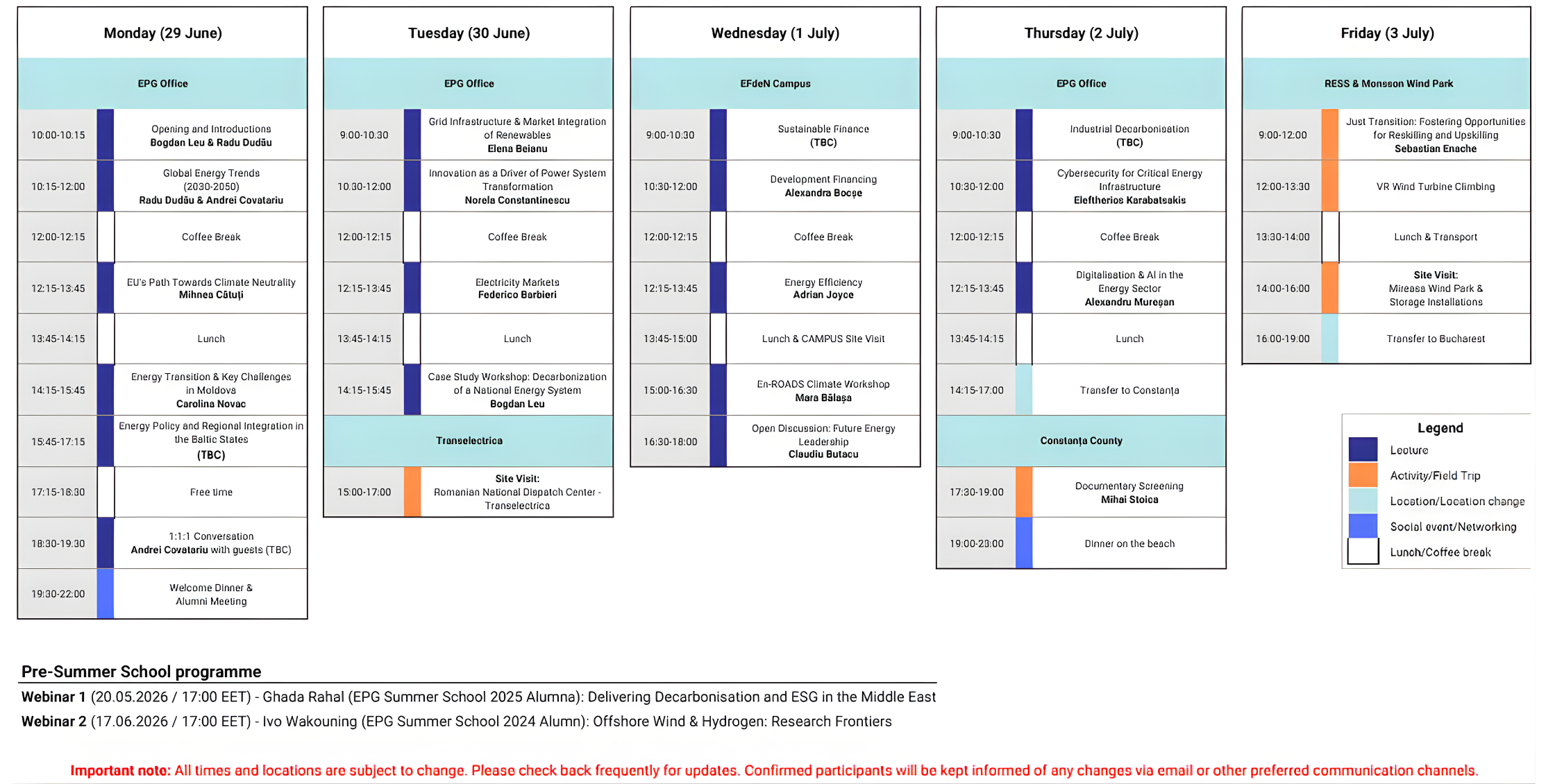
Preliminary Agenda
First Confirmed Speakers

Federico Barbieri
Policy Coordinator – Electricity & Carbon markets, Energy Traders Europe

Mara Bălașa
Senior Associate, Energy Policy Group

Elena Beianu
Policy Manager, RenewableUK

Alexandra Bocșe
Director for Institutional and International Relations, Romanian Investment and Development Bank

Claudiu Butacu
President, EFdeN / Co-Founder, European Institute for Sustainability

Mihnea Cătuți
Executive Director, Energy Policy Group

Norela Constantinescu
Deputy Director, IRENA Innovation and Technology Center

Andrei Covatariu
Senior Associate, Energy Policy Group & Nonresident Senior Fellow, Atlantic Council

Radu Dudău
President, Energy Policy Group

Sebastian Enache
Head of M&A, Monsson Romania

Adrian Joyce
Director, Renovate Campaign Europe

Eleftherios Karabatsakis
Co-founder / CEO, PlugSecure

Bogdan Leu
Associate & Summer School Director, Energy Policy Group

Alexandru Mureșan
Co-Founder / CEO Renergia
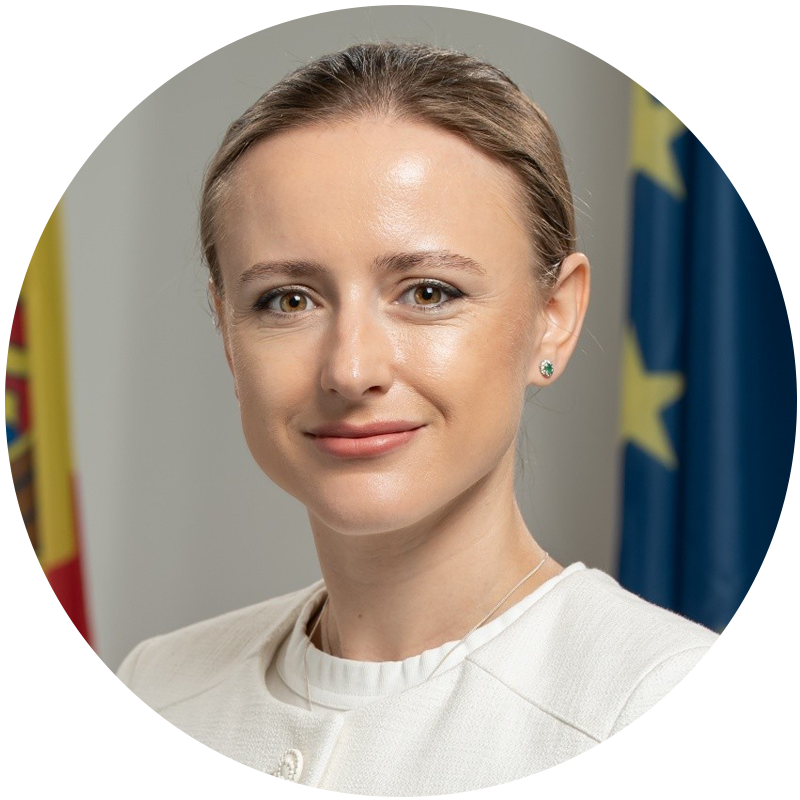
Carolina Novac
State Secretary, Ministry of Energy, Republic of Moldova

Ghada Rahal
Sustainability & ESG Expert
EPG Summer School 2025 Alumna

Mihai Stoica
Executive Director, 2Celsius
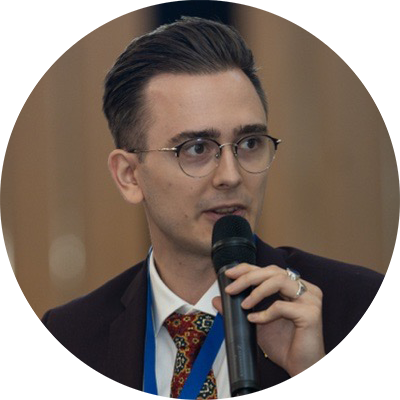
Ivo Wakounig
PhD Researcher at Eindhoven University of Technology
EPG Summer School 2024 Alumnus
650 €
Early bird
until March 1, 2026
850 €
Standard call
(for PhD and Master students a 750 € fee is available for the standard call period of application)
The participation fees include:
The participation fees don’t include:
Timeframe
09.02 – 01.03
Early Bird Call
02.03 – 05.04
Standard Call
06.04 – 07.04
Evaluation
08.04
Notification
08.04 – 22.04
Confirmation and Fee Payment
20.05
1st
Webinar
17.06
2nd
Webinar
29.06 – 03.07
Summer
School
Coordinators

Bogdan Leu
Associate & Summer School Director

Ciprian Bogdan
Office & Events Manager

Caterina Oproiu
Communications Manager

Alexandru Tremurici-Mavropol
Organisational Development Manager