Home Blog Page 39

Turkmenistan’s gas hurdles: No end in sight

Turkmenistan’s energy sector is being hit by a wave of misfortune. The latest blow to Ashgabat came this March in the guise of indefinite postponement of Line D of the Central Asia – China pipeline (CACP). This pipeline is essential to Turkmenistan’s ability to export more gas in order to receive more hard currency. Turkmenistan lost Russia as a customer one year ago, and has since provided gas only to China and Iran. However, Turkmenistan is not receiving cash for the entire China-supplied gas volumes, as part the two countries had previously closed a “debt for gas” deal.

Furthermore, Ashgabat’s relationship with Tehran has worsened, because of dispute over a gas debt. This has resulted in halted exports to Tehran, and to massive lay-offs in the Turkmen oil and gas sector.

The country’s revenues suffered when oil prices went down. The Turkmen economy is heavily dependent on oil and gas revenue, so it started to crumble as the global oil prices plunged from $115 per barrel in June 2014 to under $35 at the end of February 2016. Turkmenistan’s main revenue source is natural gas exports, estimated to make up 31% of GDP . Ranked 4th globally by total proved gas reserves after Russia, Iran and Qatar, Turkmenistan had 17.5 tcm2 in reserves, and a gas output of 72.4 bcm in 2015, up 4.5% year-on-year. The country’s total proved oil reserves as of 2015 are estimated at 600 million barrels.

Turkmenistan is a landlocked country, thus it is dependent on pipelines to export its gas on world markets. The three main export routes of Turkmenistan are: Central Asia – Center pipeline (CAC) to Russia; Central Asia – China pipeline (CACP) to China; and two pipelines to Iran: Korpedzhe-Kurt Kui (KKK) and Dauletabad-Sarakhs-Khangiran.

32 Gas market liberalisation. GEO64/2016 and its effects

As the EU moves towards committing to the decarbonisation of its economy to net-zero greenhouse gas (GHG) emissions in 2050, the Southeast European (SEE) member states are still struggling with dysfunctional energy markets, blatantly inadequate long-term planning capabilities and an overwhelming dependency on fossil fuels.

Combined, these factors represent significant impediments to the decarbonisation objectives in the region.
The successful transition towards a low-carbon future in the EU relies on both the acknowledgement of the different starting points of the SEE member states in the decarbonisation process and the resolution of the aforementioned problems. This paper uses Romania as a case study to illustrate the SEE situation.

First, this article briefly summarises the general European context and the framework through which member states will cooperate in the area of energy policy. Second, it showcases the energy and climate strategies of Romania. Third, it turns to some of the main barriers that the country is currently facing in reforming its energy markets.

Barriers to the reform of the Romanian energy markets – For all its natural resources, well-balanced energy mix and low import dependence, the Romanian energy sector is presently in disarray, facing multiple challenges to its various subsystems: energy production, infrastructure and market mechanisms. Among the most important issues are the deficit of power generation, the crisis of the country’s coal-fi red power generation, the uncertain prospect of the gas finds in the Black Sea, a failing district heating in Bucharest and other major cities, and a strained business model of the electricity and gas distribution companies. The underlying causes of these problems are erratic policymaking, weak institutional capacity and poor long-term planning. This paper focuses on the first two of the enumerated problems as the more urgent ones

The final part of the article summarises the findings, while also suggesting some avenues that may be pursued to overcome the challenges of decarbonisation in SEE.
An analysis of the evolution of electricity prices in January 2017

The accelerated growth of electricity prices on the OPCOM electricity exchange in January 2017 continues to be a controversy fueled by emotions, manipulation and incomplete understanding. Without a doubt, there are persons to be held accountable, important lessons to be learned, and things to be corrected, but this begs for a serious and objective analysis. Let’s notice from the very beginning that January – especially the second part of the month – was a very volatile period for all the regional power markets. The day-to-day variability was highest on the Hungarian and Czech markets. Further, it can be noticed that on the coupled 4M MC market, there was a stronger price coupling between the Romanian and Hungarian Day-Ahead Markets (DAM), respectively between the Czech and Slovak ones.

Nevertheless, the average price in Romania was one of the highest – after Hungary and Serbia – and considerably above the average of previous years. Indeed, a DAM base price comparison for the November – January timeframe from 2013 to 2017 shows a significant deviation from the norm in January 2017.

Two immediate questions arise: was the price increase linked to increasing volumes traded or to increasing consumption? And were there any other specific elements that influenced the market this January, in particular?

Reflections on the New Romanian Energy Strategy

The Energy Ministry posted on December 19 the Energy Strategy of Romania 2016-2030, with an Outlook to 2050. It has been a long-awaited document, on which stakeholders have for years pinned hopes about favored energy policies and from which decision-makers, public and private, expect guidance in the coming years.

Based on a rigorous and complex elaboration that spanned over more than one year, the strategy provides a diagnosis of the system’s strengths and vulnerabilities, as well as thorough long-term projections for the national energy sector.

More than 300 experts were involved in the process, contributing in several respects: they infused realism and relevant details based on their sectoral knowledge; they suggested relevant angles for the quantitative modelling that followed; and they helped frame a vision of the country’s development in the energy sector for 2030 and beyond. The numerical modelling was done using the PRIMES/GEM-E3 suite of models – property of the Greek company E3M – employed with predilection by the European Commission for about two decades now in grounding its energy and climate policy proposals.

More than a few stakeholders – companies, associations, and academics – have stated their appreciation about the professionalism, inclusiveness and accuracy evinced in the making of the new Romanian Energy Strategy. Unsurprisingly though, shortly after submitting the draft version to public debate on November 15, criticism started being voiced about both the form and the content of the document.

Romania holds first capacity auction for Isaccea – Negru Vodă pipeline

On September 5, Romanian natural gas transmission system operator (TSO) Transgaz held a long awaited first capacity auction for Transit 1 Isaccea–Negru Vodă natural gas pipeline, as Romania is compelled by EU legislation to allow third party access. The pipeline’s capacity was reserved solely to carrying Russian gas to Bulgaria but will expire on September 30. The auction was held on Hungarian platform RBP as Transgaz has not developed a gas trade platform suitable for this type of transactions.

Three companies have won the allotted capacity for Negru Vodă 1 – Kardam interconnection point at the Romanian-Bulgarian border: Bulgargaz (the largest Bulgarian natural gas distribution company), Transenergo and Wiie Romania and thus, have also won the associated capacity for Romanian-Ukrainian Isaccea interconnection point allowing them full use of this transit pipeline.

Romania’s capacity auction is a significant step in regional gas market opening. At the end of July 2016, Transgaz has signed gas interconnection agreements with its Bulgarian and Ukrainian counterparts in order to increase interconnectivity and allow bidirectional flow from Ukraine to Greece. Nevertheless, there are still challenges to overcome.

 According to EU regulations, capacity at an internal border point should, ideally, be bundled by TSOs on both sides, meaning that Transgaz and Bulgartransgaz, respectively Transgaz and Ukrtransgaz should jointly auction their border capacity. Still, Romania and Ukraine announced that they will auction capacity separately until Ukraine chooses a platform for bundled capacity auctions, while Bulgartransgaz will hold cross-border capacity auctions for the Negru Vodă 1 – Kardam interconnection point with Romania later this year on the same RBP auction platform. Bulgartransgaz was expected to hold unbundled auction capacity in September but decided against as most Bulgarian gas contracts are ongoing.

Analysis on the constitutionality of the introduction of a tax on additional profit on the holders of oil agreements

Clientul nostru, Federația Patronală Petrol și Gaze („FPPG”), ne-a solicitat să efectuăm o analiză a constituționalității introducerii unui impozit pe profit suplimentar în sarcina operatorilor petrolieri/titularilor de acorduri petroliere (“Acorduri Petroliere”) din sectorul upstream din România („Operator/i”). Acest impozit pe profit suplimentar („IPS”) ar urma să fie introdus în temeiul unei Legi privind impozitarea sectorului operațiunilor petroliere și a activităților miniere, aflate în prezent în stadiu de proiect („Proiectul”). În prezent, nu dispunem de o variantă a Proiectului care poate fi apreciată drept varianta certă avută în lucru la diferitele autorități guvernamentale implicate în procesul de redactare a Proiectului.

În aceste condiții, analiza noastră va pleca de la premisa că IPS se va aplica asupra profitului determinat conform reglementărilor contabile (i.e. a întregului profit și nu doar asupra unei părți a acestuia reprezentând câștigul peste rata normală de rentabilitate pentru industria de petrol şi gaze), înainte de înregistrarea, inter alia, a impozitului pe profit instituit prin Titlul II din Codul Fiscal, publicat în formă consolidată în Monitorul Oficial nr. 688 din 10.09.2015 și a redevenței petroliere stabilite prin acordurile petroliere în baza Legii petrolului nr. 238/2004 („Legea Petrolului”).

Vom considera ca premisă că IPS va avea un tratament mai favorabil pentru investițiile realizate după intrarea în vigoare a IPS („Investiții Noi”) comparativ cu investițiile realizate până la data intrării în vigoare a IPS („Investiții Existente”), care pot fi în diferite stadii (ex. puse în funcțiune şi incomplet amortizate, puse în funcțiune parțial, nepuse în funcțiune). Tratamentul mai favorabil este prezumat a include măsuri cum ar fi: amortizarea mai rapidă a costurilor cu investițiile noi, deducere suplimentară acordată numai pentru investițiile noi sau într-un procent mai mare, indexare numai pentru pierderile înregistrate după data intrării în vigoare a IPS etc. Plecăm de la premisa că IPS se va aplica identic pentru toate tipurile de investiţii din sectorul de petrol şi gaze (ex. onshore, offshore, neconvenţional).

 De asemenea, plecăm de la premisa că dacă Proiectul va fi adoptat, procedura de adoptare va fi conformă Constituției, legilor și regulamentelor aplicabile acestei proceduri, astfel că analiza noastră de constituționalitate se va limita strict la aspecte de drept material ce țin de instituirea unui nou impozit pe profit, suplimentar celui instituit prin Titlul II din Codul Fiscal.

Natural monopolies:the case of Romania’s distribution network

A natural monopoly exists when economies of scale are so substantial that a single firm can produce total business output at a lower unit cost, and thus more efficiently than two or more firms”.

In Romania, a number of industrial sectors that serve the public interest are strictly regulated – natural gas, railroad or electricity systems, to name a few. As such, for the local energy sector, and particularly for electricity, the transmission and distribution services are regulated as “natural monopolies”.

Conceptually, this is explained through reasons of public interest: assuming a context of fragile and inefficient markets, the regulatory body represents society’s interest. 3 In this approach, natural monopolies, as single suppliers, are seen as lowering product costs4. In other words, a company that is alone in a sector can focus its investment on the long term, which will lower the costs, while competition in such a sector would generate wasteful investment.  Simply put, “in some industries, average costs are minimized when production is concentrated within a single firm”.

Academically, natural monopolies are analyzed as excludable but not rival goods. The underlying logic is that without competition only one competitor would survive and thus generate a monopoly over that particular good. Furthermore, the state regulates the existence of natural monopolies in order to prevent private entities from going into limiting supply under the incentive of charging a price that is much higher than its costs. In the particular case where privately owned companies were granted specific licenses to operate a distribution network, this is legally defined as a public franchise: “a right granted to a firm by government that permits the firm to provide a particular good or service and that excludes all others from doing the same”.

The Threats that Cloud Romania’s Upstream Promise

The Black Sea has long been developing into a strategic geopolitical “landscape” which is key for the entire European continent and the Caucasian region. The clash between two powers like Russia and Turkey was something to be expected. There are, theoretically, small chances for a large-scale military conflict between such powers.

I hope we will not witness any escalation caused by accidents, mismanagement of military forces or isolated incidents like the recent downing of a Russian military aircraft by Turkey on the Syrian border. Moreover, despite the strategic and military tensions between the two powers, there are strong economic interdependencies, particularly in the energy sector, which should ease the tensions. The evolution of Turkish-Russian relationships rests under the umbrella of strategic and political decisions of the western world.

Russia wants western economic sanctions to be lifted, and Turkey is a crucial player in the European efforts to manage migration from the Middle East, to buffer the spread of the Syrian conflict and Isis/Daesh and, in the long run, Turkey is vital to Europe’s energy security. Therefore, the relationship between Turkey and Russia should be regarded in the much larger context of relationships of the EU and Nato with each of the two actors.

These tensions between the two countries could affect upstream operations in the Black Sea. Military patrols, economic and environmental challenges, field unitization disputes, manipulation of domestic energy policies, the Bosporus and its potential challenges, challenges to the development of midstream infrastructure – these are just some of the tactics that could be brought into play to stall upstream developments in the Black Sea basin.

The household energy market in Romania is in a process of liberalization. Or is it?

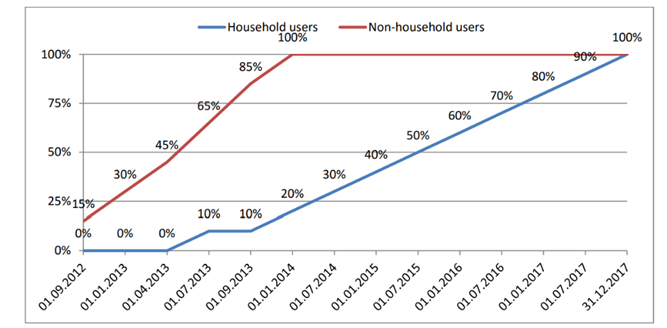
The adoption of a system that will allow a step-by-step liberalization of energy prices has proved to be an inspired measure, as Romanians would not have been ready for a sudden, direct shift to a free market.

The ongoing debates in the Romanian society on vulnerable consumers emphasize just that. By comparison, the authorities in Bulgaria opted for a full liberalization of the energy market in 2016.

Although about 30% of Bulgaria’s population can come under the definition of vulnerable consumer, the authorities preferred this option, in order to avoid a recurrence of past protests, caused by the increase of the energy price, actions that resulted in February 2013 in the resignation of the Boyko Borissov Government.

The liberalization effects in Bulgaria will most likely be visible in the following period.0F 11F 2 It is important to remember that in June 2012, the Romanian authorities released the official calendar of liberalization of energy prices.

Water tax for Hydroelectric Power Plants

This analysis focuses on the tax applied to the water used by hydroelectric power plants in Romania. This study also includes information on similar water taxes around Europe and a comparison between them and that applied in Romania.

Although set in Romania in 2000 as a small tax meant to raise funds for development of hydro projects, this fee has increased significantly over the years, making it even harder for the hydroelectric producers’ activity.

In the category of invented-out-of-nothing taxes one can find the fee imposed by NARW – the National Agency “Romanian Waters” (ANAR, in Romanian) for water used by power plants producing electricity from hydro sources (micro or large scale). True, this is not a fee that exists only in Romania, but it is nonetheless a bizarre cost that hydroelectric producers must pay. Actually, more than 40% of the energy produced from hydro sources in the 27 countries analyzed, at European level, incurs different types of water taxation.

Out of these countries, 11 (9 of which are EU member states) pay different types of fees for hydro power generation, with Romania paying the most for water expenses, according to Hidroelectrica‟s (the main hydro electricity producer in Romania) special administrator.