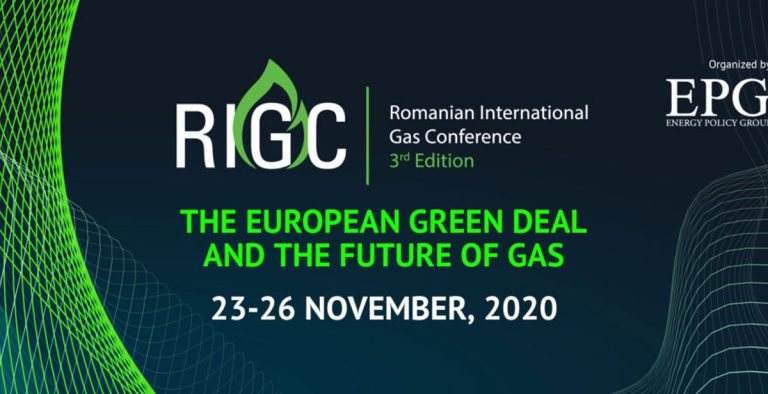
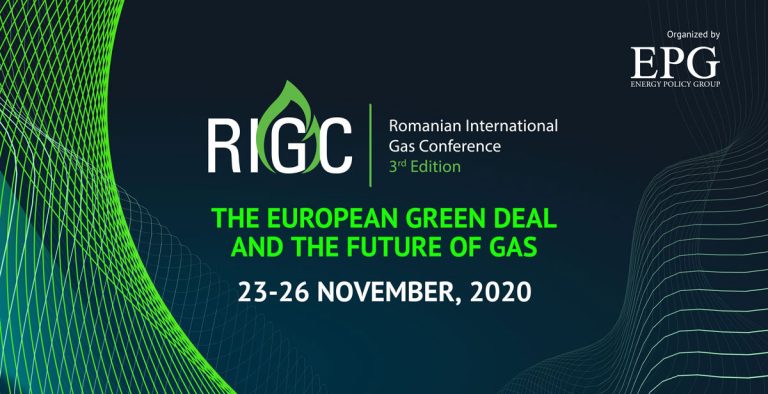
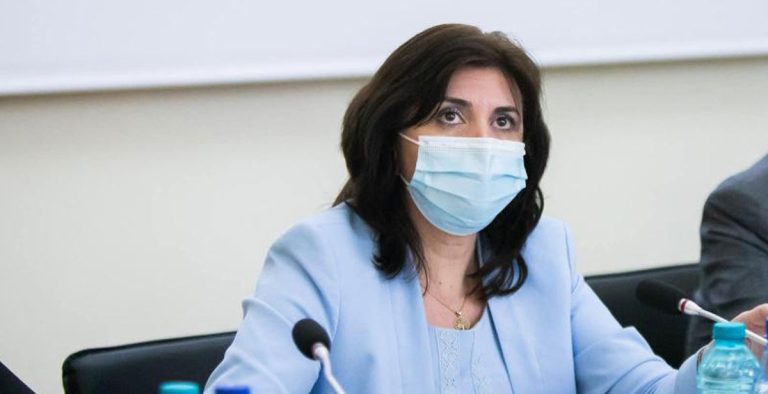
Între 23 și 26 noiembrie, va avea la București o importantă serie de dezbateri despre viitorul sectorului gazelor naturale. Experți de marcă și oficiali guvernamentali din România dar și din alte state din zona noastră, precum Polonia, Bulgaria, Grecia vor participa la Romanian International Gas Conference (RIGC) 2020, organizat anul acesta sub tema: The European Green Deal and the future of gas.
Conferința online RIGC 2020 este organizată de Energy Policy Group, think-tank românenesc axat pe probleme de energie și mediu.
Conferința online începe azi la ora 10.00. e-nergia.ro este partener media al evenimentului.
Sectorul gazelor naturale din România ar putea beneficia de pe urma construirii unor noi unități în cogenerare de înaltă eficiență. În prezent, Ministerul Economiei, Energiei și Mediului de Afaceri conlucrează “îndeaproape cu Consiliul Concurenței pentru a identifica în ce mod poate fi prelungit prelungită schema de sprijin pentru unitățile în cogenerare”.
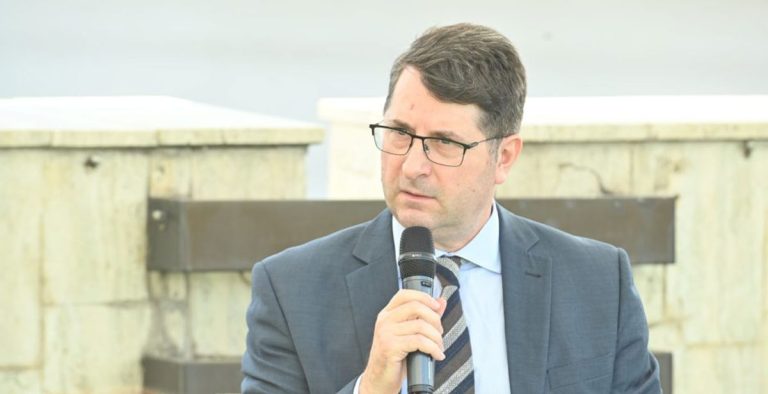
Prezent la conferința “Romanian International Gas Conference” (RIGC), organizată de Energy Policy Group (EPG), Dan Drăgan, secretar de stat în cadrul Ministerului Economiei, Energiei și Mediului de Afaceri, a răspuns la o întrebare lansată de Energynomics. “Ne dorim să obținem o formulă cât mai adecvată pentru a încuraja investițiile în asemenea unități, iar în acest sens lucrăm intens și ne consultăm constant cu Comisia Europeană”, a declarat Dan Drăgan.
Domnia sa și-a exprimat convingerea că gazele naturale vor juca un rol important și pe viitor, întrucât vor asigura o tranziție blândă spre decarbonizare. “Este esențial în România să folosim gazul natural în acest scop. Va fi necesară o cotă mai importantă de investiții, inclusiv pe partea de gaze naturale, iar cadrul viitor de reglementare trebuie să permită dezvoltarea tuturor opțiunilor”, a mai spus el.
The oil and gas sector has taken a hard hit during the COVID-19 crisis. The unprecedented halt in global mobility resulting from months of lockdown in most countries, followed by persisting travel restrictions, has crushed demand for energy, leading to record-low oil prices. According to the International Energy Agency (IEA), global energy demand is estimated to have decreased by 5% in 2020 compared to 2019, a figure not seen in the past seven decades, with coal and oil suffering the most significant losses, with estimated falls of 7% and 8% respectively[1].
Companies in the sector made downwards revisions to their long-term oil price outlook, cut tens of thousands of jobs and significantly reduced investments.
This is not the only major challenge that the sector is facing. Even before the health crisis, the pressure to shift towards a more sustainable business model was mounting from both consumers and investors. Environmental NGOs have been highly active in monitoring and raising awareness about the environmental impact of new oil and gas projects, and even taken companies to court for delaying progress regarding the 2 degrees Celsius objective set out by the Paris Agreement. Once hailed as key contributors to the spectacular economic growth after World War II, the oil & gas industry is now losing its dazzle, increasingly being associated with greenhouse gas emissions and environmental damage. Investors are also becoming more cautious with regard to the carbon footprint of their portfolios, as multiple fossil fuel projects are at risk of becoming stranded assets.
Major companies are aware of this radical shift in public perception and are not willing to die out as polluting dinosaurs in a world focused on combating climate change.
One of the defining features of the industry is its capacity to orient itself for the long term, so naturally they cannot ignore the existential risk that climate change mitigation entails for their business model. In recent years, oil & gas companies have stepped up investments in low carbon technologies, from renewable energy sources, to electric vehicle batteries and charging stations, and alternative fuels (hydrogen, biofuels). They have also contributed to research on emerging technologies such as carbon capture and storage. This is mostly the case with European companies, that have set specific targets for the growth of their low carbon businesses and revamped their discourse to include climate change as one of their concerns. Their American counterparts have so far rejected the idea of a significant transformation of their business model, continuing to focus on fossil fuels.
This change of strategy has been embodied by the adoption, this year, of climate neutrality targets for 2050 by all European majors (BP, Shell, Total, Eni and Repsol), to varying degrees of ambition. However contradictory it might seem to associate climate neutrality with fossil fuel companies, the targets are arguably reachable should they equate emissions output with emissions that can be absorbed by carbon sinks. Achieving the net zero targets will involve a mix of solutions to reduce emissions from their operations, by increasing efficiency and reducing flaring; through investments in renewable energy and other low-carbon technologies; and by offsetting remaining emissions. A company has some degree of flexibility regarding the amount of emission reductions when it fixes a carbon neutrality target, because it can choose how much of its remaining emissions it will offset; at global level, this is not possible, as the planet’s carbon sinks are limited[2]. In responding to these targets, companies are often criticized for failing to outline a clear roadmap, and to what extent carbon offsets and/or carbon capture and storage will contribute to their targets[3].
Another key issue is whether companies are including so-called scope 3 emissions (coming from their entire value chain, notably the end use of the products they sell) in their net zero targets, which weigh the heaviest in their carbon footprint. The net-zero targets mostly cover scope 1 emissions (“direct emissions” generated by company facilities) and scope 2 emissions (stemming from the generation of energy the company uses, such as electricity or heat), which represent on average less than 10% of their total emissions[4]. With increasing pressure to step up their climate ambitions, all European majors partially incorporated scope 3 emissions in their climate objectives, either by pledging to reduce the emissions intensity of the products they sell, or, for the more ambitious, to reduce emissions on scope 3 in absolute terms, either worldwide or within a geographical perimeter. This is a positive development, but it falls short of providing a clear picture of the reductions in emissions that will be achieved. Notably, in the case of the intensity-based approach, it does not guarantee that overall emissions will decrease if production increases[5].
Looking beyond the sustainability push from investors and consumers, could this new climate-oriented approach from oil and gas companies be seen as a result of the market telling them that their golden days are over?
The energy sector’s weight in the S&P 500 index has plummeted to a historic low of 2 percent this year[6], but this decline started long before the pandemic, and has disproportionately impacted fossil fuel companies. This is a worrying trend for an industry that needs to mobilize huge amounts of investment to continue projects and accelerate plans for a low carbon transition. On the other hand, renewable energy stocks have seen strong performances this year, benefiting from rapid sector growth, driven by plummeting technology costs and enabling policies, as well as from growing interest in sustainable investments.
The outlook for oil demand, a long-debated matter with important implications for the industry, is now the subject of renewed evaluation, as the pandemic continues to disrupt mobility patterns. BP sent shockwaves across the industry as the first oil major to commit to cutting oil and gas production by “at least” 40% by 2030; in this year’s edition of their flagship Energy Outlook, the company went as far as calculating that peak oil was already reached, with oil consumption not returning to 2019 levels. The other majors did not rush to confirm BP’s forecast, indicating they will continue to increase fossil fuel production until 2025[7].The newly released World Energy Outlook 2020 of the IEA also shows caution in forecasting peak oil in the near future. In the Stated Policies Scenario and the Delayed Recovery Scenario oil demand flattens out no earlier than 2030, motivated by rising demand for mobility in emerging markets, as well as for petrochemicals.
With the current price environment and the rather grim future prospects, could an overhaul of the oil& gas sector be envisaged?
Oil majors have made it clear that they will continue to produce oil and gas to satisfy current and future demand, and they argue that these revenues are crucial to finance their energy transition. Demand in advanced economies might have stabilized, but it is still poised to rise in developing economies – Asia will account for 77% of oil demand growth through 2025[8]. The diversification of their portfolios to include more low carbon options is an important step in adapting to a carbon-constrained world, but it is still too early to assess whether it will lead to a transformation of business models.
There are some key changes emerging: non-conventional oil & gas projects are on hold, due to high production costs and low global prices, but exploration and production will continue in conventional reserves, privileging low-cost projects with low production costs. Natural gas will be the main driver of growth in the sector, with most companies anticipating a significant increase in gas demand. While prospects for gas in established markets start to deteriorate by mid-2020, emerging markets in Asia will provide robust growth through 2030[9]. There are several drivers of growth: the push to replace coal in industry and power generation with a dispatchable, less carbon-intensive energy source and decreasing LNG costs, which make gas accessible to emerging markets in Asia. Moreover, companies still prove capable of securing funding for new projects – for example, Russia’s giant Arctic LNG 2 project, led by non-state Russian company Novatek, in partnership with Total, has managed to secure $9.5 billion in financial support from international lenders this year[10]. It is the high-cost, high-risk projects that will struggle to obtain financing.
The energy transition must include oil& gas majors.
With their innovation capacity and established reputation, they can play an important role in the radical transformation of the energy sector, that requires mobilization from everyone in the game. Some crucial technologies require more research& innovation and companies have a critical contribution to make. Examples include carbon capture and storage and offshore wind, technologies in which oil & gas majors can apply know-how from their traditional activities. They can also adapt existing infrastructure to less carbon-intensive activities – oil refineries can be converted to biofuels, service stations can provide electric charging facilities.
Although not yet the sign that systemic change is underway in the oil and gas sector, the climate neutrality goals represent an important step ahead in quantifying climate ambitions and keeping companies accountable to their pledges. The urgency of tackling climate change is clearer than ever, and the energy sector as whole will need to strike a balance between satisfying the energy needs of the future, while also significantly cutting its greenhouse gas emissions. For companies to truly rise to the challenge, governments will have to be more ambitious and consistent regarding climate policies, that would change consumption patterns and shift investments from fossil fuels to low carbon solutions.
“A major challenge for the natural gas sector will come from the area of taxonomy on sustainable investment. Instruments such as the Modernization Fund represent a unique opportunity for the natural gas sector,” Radu Dudau, director Energy Policy Group, said during “European policies for the new economy” conference organized by EM360.
“The government must manage these funds correctly and intelligently. We have the chance of the modernization fund that we must use, so that the transition from coal to cleaner resources is based on natural gas. The institutional and government’s ability to use these funds intelligently is very important. It represents the last train for these transition fuels. The industry needs to understand that there are very harsh restrictions, but that there are also many opportunities and money that you can access by following new trends and abandoning conventional approaches.”
The 3rd edition of the Romanian International Gas Conference (RIGC), a flagship annual English-language event of the Energy Policy Group (EPG), will start on November 23. The 2020 edition is conceived as an on-line series of events unfolding as a sequence of four webinars, from November 23 to 26. The backdrop of RIGC 2020 is the European Green Deal, which sets the continent’s economy on a uniquely ambitious track to net-zero carbon emissions by 2050.
RIGC 2020 will focus on the gas sector’s response to the European Green Deal and the implications of the post-Corona recovery on Romania and the region.
In this context, the gas industry will have to bring to the fore a convincing long-term decarbonization strategy, around the production and use of biogas/biomethane, power-to-gas, and carbon-free hydrogen, alongside the needed infrastructure – all ‘futureproof’ and at optimized costs.
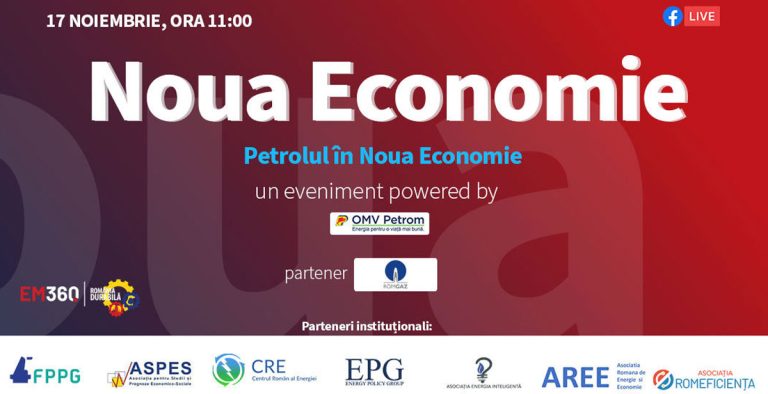
România Durabilă şi EM360 organizează marţi dezbaterea “Petrolul în Noua Economie”, pentru a creiona soluţii de atenuare a impactului negativ al pandemiei asupra sectorului energetic.
Pandemia de SARS-COV-2 a afectat economia la nivel internaţional, iar România nu face o excepţie de la această realitate. Încă de la începutul pandemiei statul român a căutat soluţii pentru stoparea efectelor negative a crizei care se profila, prin acordarea de facilităţi şi a pregătit strategii pentru relansarea economică. Până în momentul în care nu vor fi însă adoptate o serie de măsuri coerente şi aplicabile, în acord cu situaţia economică actuală, nu vom putea vorbi despre redresarea şi dirijarea economiei naţionale către un trend ascendent.
Până în acest moment, mediul de afaceri a păstrat un ton optimist – au fost refăcute strategiile de dezvoltare şi de finanţare a afacerilor şi în special s-a pus accent pe găsirea de soluţii de protejare a angajaţilor, de creare a unui mediu cât mai sigur de muncă pentru a putea asigura continuitatea business-ului. Este evident că statul român, ca şi întreg mediul de afaceri, trebuie să fie foarte deschis la semnalele din piaţă, să se adapteze din mers, să adopte măsuri de sprijin atât pe termen scurt pentru ieşirea din criză, dar şi pe termen lung pentru relansare economică.
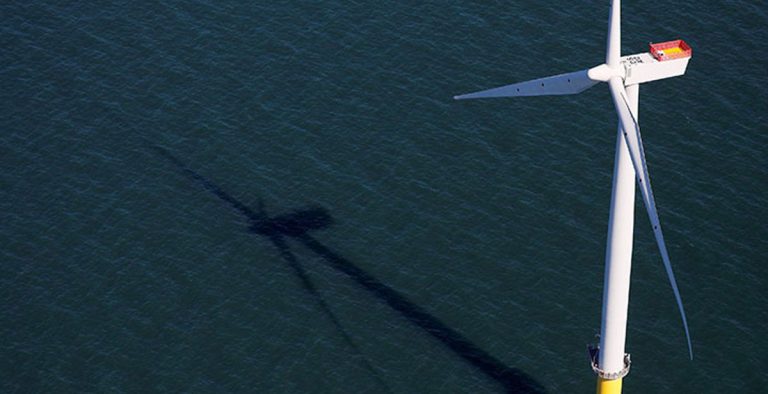
Potrivit unui studiu realizat de Energy Policy Group (EPG) potențialul de energie eoliană offshore al României are o capacitate naturală potențială de 94 GW, din care 22 GW folosind turbine fixe. Producția anuală de energie rezultată ar putea ajunge la 239 TWh, din care 54,4 TWh produși de turbine fixe. Ar însemna o cantitate foarte mare de energie, având în vedere că în primul semestru al acestui an energia produsă având ca sursă vântul a fost de 3,84 TWh, iar cea produsă în termocentralele pe lignit a totalizat 3,21 TWh.
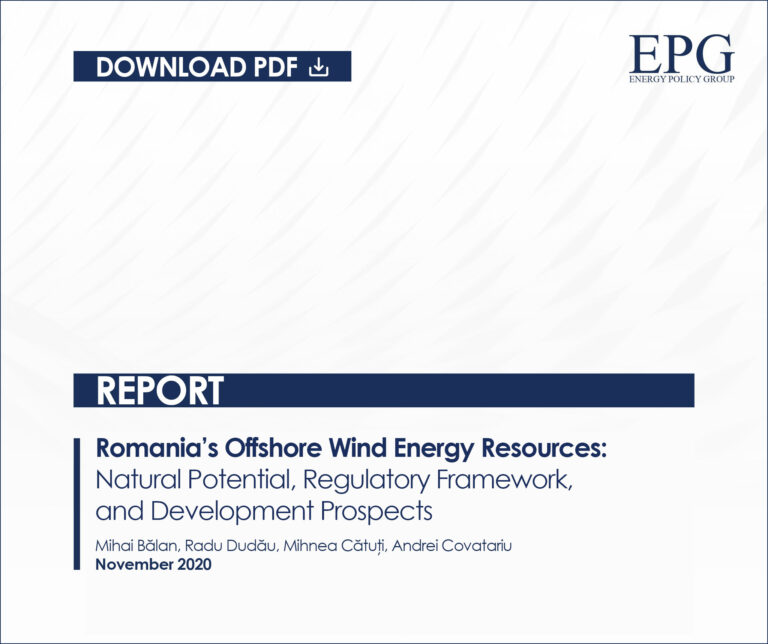
Prin prisma multiplelor oportunități de finanțare, atât publice, cât și private, disponibile pentru România, momentul actual este propice lansării investițiilor în capacități eoliene offshore situate în Marea Neagră, susţin realizatorii studiului „Romania’s Offshore Wind Energy Resources: Natural Potential, Regulatory Framework and Development Prospects”. Având în vedere dezvoltarea viitoare a capacități eoliene offshore, Guvernul trebuie să pregătească Planul Spațial Maritim național (MSP), conform Directivei MSP a Uniunii Europene. Acest plan are o importanță critică pentru promovarea intereselor statului și evitarea fricțiunilor dintre activitățile maritime potențiale și prioritățile strategice. De asemenea, este oportună crearea unui cadru regional de cooperare și integrare cu Bulgaria în acest sector. Un proiect eolian offshore comun va fi benefic atât pentru creșterea gradului de conectare a rețelelor, cât și în perspectiva cuplării piețelor de electricitate ale celor două state membre, se arată în studiul citat.
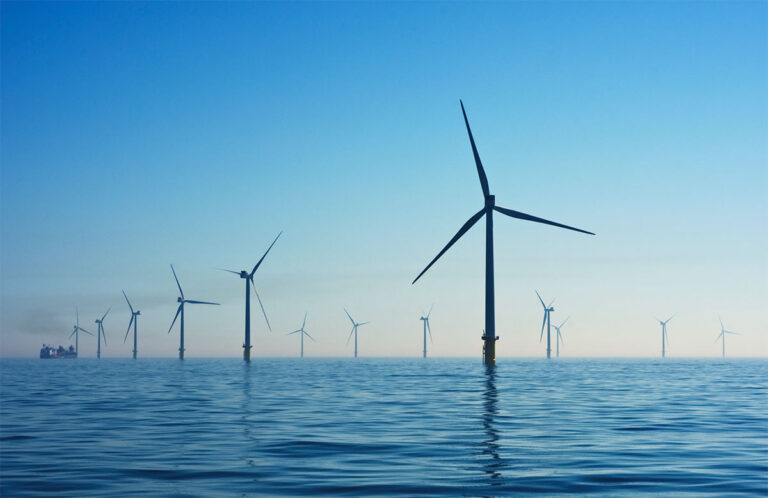
Offshore wind power is regarded as a likely pillar in reaching net-zero greenhouse gas (GHG) emission by 2050, as envisioned by the European Green Deal. Europe is home to some of the world’s most significant offshore wind resources. Better tapping into this potential will be addressed in the Commission’s upcoming 2020 Offshore Wind Strategy, expected to bolster a rapid expansion of offshore wind on the continent, from the current 20 GW installed capacity to 450 GW by 2050. Offshore wind generation can offer numerous advantages: high full-load hours, high operating hours, rather low variability and, consequently, greater predictability and lower forecast errors, as well as lower balancing power needs compared to onshore wind and solar PV.
The present study assesses the natural and technical potential of Romania’s offshore wind sector, finding an estimated total potential natural capacity of 94 GW, out of which 22 GW could be installed as fixed turbines, leading to a total Annual Energy Production (AEP) of 239 TWh, with 54,4 TWh from fixed turbines. The data analysed in this report show that wind speeds increase with the distance to the shore, with only the central part of the deep-water sector having more sizeable mean wind speeds (close to 7 m/s). A large part of Romania’s Exclusive Economic Zone (EEZ) consists of a deep-water area (>50 m) that is more suitable for floating platforms. Nonetheless, several offshore wind farms in Europe have been recently built at about 60 km from shore, a distance that is just within the Romanian transition area from shallow to deep water. The study identifies two potential clusters with most favourable conditions for a first stage of offshore wind development, based on fixed turbines: one with capacity factors between 33-35%, in water depths below 50 m at 40-60 km from the shore – an area that strikes the right balance between wind resources and costs of the required offshore network, given the possibility to inject the output in the Constanța Sud electrical substation and the proximity to the Port of Constanța.
The other area presents marginally better wind resources, but the existing onshore power transmission line is further inland and the connection grid would have to be extended through the Danube Delta, which is a protected area. To develop its wind potential in the Black Sea, Romania needs to address a number of key issues, the most significant being overcoming grid challenges. Any new offshore wind farm developed in Romanian waters will have to be connected to the grid in Dobrogea, where a large part of the country’s power generation assets are already located and additional renewables are planned to be developed, alongside two new nuclear units at Cernavodă, to the effect of almost doubling the installed capacity in an area with quite limited local energy demand. A separate issue is the offshore grid connections. As project size and distance from shore increase, higher voltage lines are used to minimize electrical losses. Large projects built farther away from shore may use a connection for high voltage direct current (HVDC), leading to higher up-front costs.
To avoid unnecessary spending and optimise offshore infrastructure costs, advanced coordinated planning is paramount, starting with the phase of maritime spatial planning. The government should prepare, with close and early involvement of the relevant stakeholders, the national Maritime Spatial Plan (MSP), as required under the MSP Directive. The MSP is critically important in advancing state interests and lowering the risk of conflict between potential activities and policy priorities: shipping, military zones, fishing, environmental and biodiversity impact, archaeological sites, as well as other facilities and economic activities.
Collaboration and investment by wind farm developers must be encouraged with the purpose of facilitating timely construction and maximising common utilisation of offshore connections. The offshore wind electricity production will have beneficial effects for the Romanian power markets. The energy system would benefit from a more constant power output and increased forecast accuracy, which reduces costs related to power management and balancing. Then, less volatile electricity production increases the offshore producers’ odds to compete on futures markets, with medium and long-term delivery products, which have lower commercial risk than the products offered by their onshore peers. Assuming increased interconnectivity of the regional market, the additional clean electricity will limit the room for fossil fuel-based generators on the spot markets.
Development of offshore wind farms should also be planned to facilitate an accelerated decarbonisation of key sectors such as transport and industry, either through direct electrification using renewable energy, or through the use of hydrogen. Creating demand for clean hydrogen will also help ease the difficulties of evacuating the electricity produced by offshore wind farms out of the Dobrogea region. If Romania makes efficient use of the available EU financial instruments for clean energy development, it is well positioned to become a premier producer of clean hydrogen in Southeast Europe and can develop into a regional exporter. The Dobrogea region, in particular, has all the prerequisites for hosting a hub of hydrogen development, as it has both exceptional prospects to produce clean hydrogen by means of onshore and offshore renewable sources, and potential for significant local demand from refineries and steel making industry, district heating, decarbonised port activities, as well as naval transport.
Expanding port capacity is paramount. A well-equipped port facility within economic distance from the offshore wind development areas is a key prerequisite, considering that components such as foundations, platforms or substations are manufactured directly at the nearest port facility, which also plays a key role in operations and maintenance (O&M). This highlights the need to encourage and support the modernisation of port facilities and infrastructure to host larger turbines, ramp up volumes, cater to operation and maintenance, develop training facilities and decommissioning centres for fixed and floating turbines. Ports are also important for integrating the energy output of offshore power generation, either as direct energy consumers or by potentially becoming hubs for clean hydrogen. The Port of Constanța can, therefore, expand its strategic position in the Black Sea and grow into a regional pole of decarbonisation, while providing the basis for offshore wind development in the entire Black Sea region.
Romania also needs to pursue the strategic aim of attracting a significant share of the new supply chains that are being created across Europe’s offshore wind industry. The sector creates significant added value to the EU economy beyond just in the energy system, including in sectors such as electrical equipment, machinery, metals, construction works, telecommunications, etc. When it comes to the jobs that the offshore wind industry creates, a significant number is required for the installation, building of foundations, planning and O&M processes, which can mostly be covered with national workforce. In longer term, reasons of cost efficiency will lead to relocating part of the manufacturing chain, potentially towards Romania and the region.
România are un potenţial uriaş de a produce energie din surse eoliene offshore, ceea ce ar putea majora de peste patru ori cantitatea de electricitate generată anual la nivel naţional, arată un studiu al Energy Policy Group (EPG).
Studiul intitulat „Romania’s Offshore Wind Energy Resources: Natural Potential, Regulatory Framework, and DStudiul intitulat „Romania’s Offshore Wind Energy Resources: Natural Potential, Regulatory Framework, and Development Prospects” analizează potenţialul de energie eoliană offshore al României, identificând o capacitate naturală potenţială de 94 GW, din care 22 GW folosind turbine fixe. Producţia anuală de energie rezultată ar putea ajunge la 239 TWh, din care 54,4 TWh produşi de turbine fixe.
Spre comparaţie, producţia totală anuală de energie a ţării este între 50 şi 60 de TWh.
„Energia eoliană offshore poate fi un pilon pentru atingerea obiectivului de neutralitate climatică a continentului european în 2050. Europa are resurse eoliene offshore semnificative şi un avantaj tehnologic apreciabil la nivel global. Exploatarea acestui potenţial este obiectivul viitoarei Strategii pentru energie regenerabilă offshore a Comisiei Europene, ce urmează a fi publicată în cursul lunii noiembrie. Se aşteaptă ca Strategia UE să susţină o dezvoltare rapidă a resurselor eoliene offshore, de la o capacitate instalată de 20 GW în momentul de faţă, până la un maximum estimat de 450 GW în 2050”, spun autorii studiului, conform Agerpres.
Analiza arată că din peste 13.500 de clădiri analizate, 45% nu sunt reabilitate termic sau energetic.
Din 17.819 clădiri ale unităților școlare din România, doar pentru 11.571 au fost completate datele privind accesul la utilități, potrivit prezentării făcute de Radu Dudău, președintele EPG. Este vorba despre date extrase din baza de date a Ministerului Educației, din programul SIIIR (Sistemul de Informații Integrat al Invățământului din România).
Din aceste 11.517 de unități, 16%, adică 1.874 de clădiri nu erau conectate la o rețea de apă potabilă. 43% nu erau conectate la o rețea de canalizare, iar 63% dintre clădiri nu erau conectate la rețeaua de gaze naturale, potrivit edupedu.ro.
Utilizăm cookie-uri pentru a optimiza experiența de navigare și pentru a analiza traficul site-ului. În timp ce cookie-urile strict necesare sunt active permanent pentru a asigura funcționarea paginii, avem nevoie de consimțământul dumneavoastră pentru cookie-urile de analiză și marketing. Află mai multe: Politica de cookies / Politica de confidențialitate.
Funţionalităţi
Always active
"Stocarea tehnică sau accesul sunt strict necesare pentru scopul legitim de a permite utilizarea unui serviciu specific solicitat explicit de către abonat sau utilizator, sau pentru scopul unic de a efectua transmiterea unei comunicări printr-o rețea de comunicații electronice.
Preferinţe
Stocarea tehnică sau accesul sunt necesare pentru scopul legitim de a stoca preferințele care nu sunt solicitate de abonat sau utilizator.
Statistici
Stocarea tehnică sau accesul sunt folosite exclusiv pentru scopuri statistice.The technical storage or access that is used exclusively for anonymous statistical purposes. Without a subpoena, voluntary compliance on the part of your Internet Service Provider, or additional records from a third party, information stored or retrieved for this purpose alone cannot usually be used to identify you.
Marketing
Stocarea tehnică sau accesul sunt necesare pentru crearea de profiluri de utilizator pentru a trimite publicitate sau pentru a urmări utilizatorul pe un site web sau pe mai multe site-uri.