Publication

Publication

Topic

Topic

Author

Author

Year

Year
Search

Bridging the Energy Performance Gap: Guidelines for Achieving High-performing Renovations in Central and Eastern Europe

The revised Energy Performance of Buildings Directive (EPBD) and the Energy Efficiency Directive (EED) introduce new energy performance standards and targets for the rate and depth of building renovations. These measures aim to align the sector with the EU’s decarbonisation pathway toward climate neutrality by 2050, but such efforts risk being undermined if, once completed, renovations fail to achieve the expected energy savings and reductions in CO₂ emissions. Drawing on country assessments and stakeholder consultations in Bulgaria, Romania, Poland, and Croatia, a newly released OUR-CEE guide provides a set of measures for national and local policymakers to address underperformance in public building renovations.  The measures reflect barriers and enabling factors identified across the region and are structured to cover all stage of the renovation process: financing, planning, implementation, and monitoring. Author’s Insights: “Closing the energy performance...
National Assessment of Carbon Management Potential in Romania’s Just Transition Regions

This study outlines the inputs needed to assess both the implementation and socio-economic impacts of carbon management (CM) technologies in Just Transition regions.  It suggests that CM technologies could play a significant role in supporting some of Romania’s Just Transition regions by enabling emissions reductions, as well as maintaining industrial activity and safeguarding employment in regions reliant on heavy industry. Romania is well placed to advance these solutions, given the concentration of hard-to-abate sectors in these regions and favourable geological conditions for CO₂ storage.    Author’s Insights: “Given the economic vulnerability of Just Transition countries, carbon management could offer a viable decarbonisation pathway while supporting the transformation...

Sustainability and Constraints in the Building Sector Under the ZEB Requirements 

This study analyses the Zero-Emission Building (ZEB) standard and the mandatory calculation and disclosure of Life-Cycle Global Warming Potential (GWP) for new buildings within the EU’s Energy Performance of Buildings Directive (EPBD). The new extensive body of legislation was created to achieve an energy efficient, sustainable, and decarbonised building stock by 2050.  EPG experts argue that the provisions for new buildings significantly expand on what constitutes a “sustainable” building. While energy use and carbon emissions from buildings’ operation remain a central concern, the new regulatory framework adds a wider perspective, which includes circularity, renewable energy sources, and whole-life carbon impacts. Author’s Conclusion: “The study identifies several levers for policy development at the national level, essential to strengthen the implementation of the EU policy framework to...

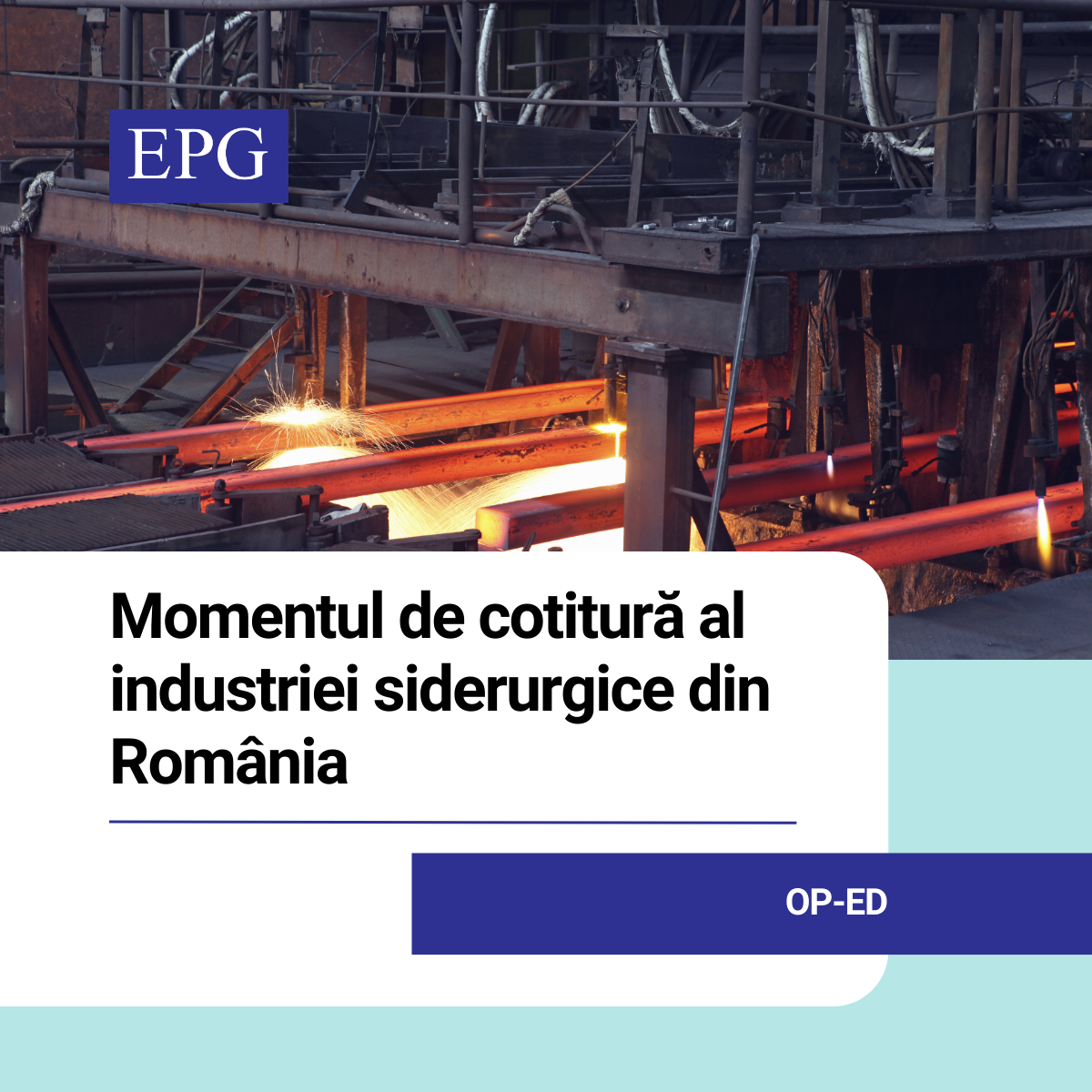
Momentul de cotitură al industriei siderurgice din România

Noul Op-Ed EPG prezintă o radiografie a situației sectorului siderurgic românesc, care s-a confruntat în ultimii cinci ani cu o serie de provocări, cât și cazul Liberty Steel Galați, singurul producător de oțel primar din România. Prețurile ridicate și volatile la energie, presiunea decarbonizării, accesul inegal la finanțare și ajutoare de stat, competiția neloială cu producători din Asia și tarifele comerciale impuse de SUA au afectat grav producția siderurgică. Unele combinate și-au suspendat activitatea, iar altele au trecut prin procese de restructurare sau schimbări de proprietari. Autoarele subliniază importanța stimulării cererii de oțel cu emisii reduse, inclusiv prin proiecte de...

Se află Europa într-un nou moment 1973? 

Noul Op-Ed EPG susține că prosperitatea și securitatea pe termen lung a Uniunii Europene (UE) depind de renunțarea la dependența structurală de importurile de combustibili fosili. Autorul evidențiază modul în care crizele energetice recurente (de la șocul petrolier din 1973 până la recentele creșteri ale prețurilor la petrol și gaze) au scos la iveală vulnerabilitatea Europei față de piețele volatile de hidrocarburi și furnizorii guvernați de o geopolitică incertă.  Deși UE a redus dependența de energia rusească după criza din 2022, aceasta continuă să depindă puternic de importuri de petrol și gaze, plătind aproximativ de trei ori mai mult pentru...

Is Europe Having Another 1973 Moment?

This Op-Ed argues that the European Union’s long-term prosperity and security depend on breaking its structural dependence on imported fossil fuels. It highlights how recurring energy crises (from the 1973 oil shock to the recent surge in oil and gas prices) have exposed Europe’s vulnerability to volatile commodity markets and suppliers whose political trajectories are uncertain at best. While the EU has reduced its reliance on Russian energy since the 2022 crisis, it still relies heavily on imported oil and gas and pays about three times more for natural gas than industries in the United States. To avoid repeating past...

National Study on Public Perception on Carbon Management in Romania

This study analyses how citizens, local communities, industry, civil society, and public authorities in Romania understand and evaluate carbon management technologies, in particular carbon capture and storage (CCS), considered among the relevant solutions for reducing emissions in hard-to-abate industrial sectors.    The analysis is based on a national survey, focus groups, and interviews with relevant stakeholders. These methods provide an integrated picture of public awareness. They also show how citizens perceive the risks and benefits, and under what conditions these technologies could gain social acceptance.  Author’s Insights: “The level of public awareness regarding CCS remains low, but when citizens receive clear and...

The Role of the 2028–2034 MFF in Shaping Industrial Transformation in Central and Eastern Europe

On 16 July 2025, the European Commission launched the negotiations on the EU’s next long-term budget by publishing its proposal for the 2028–2034 Multiannual Financial Framework (MFF). The MFF remains the EU’s main financial tool for turning common political goals and priorities into concrete investments, providing the stability and coordination of spending essential for some EU policy objectives. The proposal for the future financial plan, worth EUR 1.98 trillion, equivalent to 1.26% of the EU’s Gross National Income (GNI), marks a significant restructuring of EU spending, shifting from programme- to policy-based budgeting and from cost- to performance-based funding. This shift...

The Mid-term Review of the 2021-2027 Cohesion Policy: An Opportunity to Accelerate Industrial Transformation in the CEE Region

The Cohesion Policy, often described as the European Union’s (EU) main investment instrument within its Multiannual Financial Framework (MFF), seeks to promote balanced development across Member States by reducing economic, social, and territorial disparities between regions. It accounts for roughly one third of the 2021-2027 EU MFF, with €392 billion allocated to the design and implementation of targeted projects. The Central and Eastern Europe (CEE) countries are among the main beneficiaries, due to existing structural and historical deficiencies, including lower levels of economic development, weak infrastructure connectivity, and a high share of less developed regions. There are four main funds...